
| The Ashton Residence | |
| Type | House, Large |
|---|---|
| Constructed | 1861 |
| Also known as | Oakridge College Student Center |
| Organization | Oakridge College |
| Related events | The Ashton Residence is Donated to Oakridge College |
Ashton Residence
The Ashton Residence is one of the oldest surviving private houses associated with Briarmont’s early timber era and one of the most visible reminders of the Ashton family’s complicated place in local history. Built near Hartwell Manor and later absorbed into the Oakridge College campus, the house began as a family residence, became an inherited burden, and was eventually transformed into a public academic and student space.
Construction and Early Purpose
The Ashton Residence was commissioned by Clarence Ashton in the late 1850s, during the early expansion of Hartwell Timber Company. At the time, Clarence was serving as one of Elias Hartwell’s most trusted operational men, responsible for the practical systems that allowed the company to move labor, supplies, teams, and timber at scale. His position brought him both income and influence, and the house reflected that new standing.
Construction was completed in 1861.
Clarence did not design the residence as a small private home. From the beginning, it was built as a family house large enough to accommodate his aging parents as well as his younger brother Edmund’s future household. This arrangement reflected Clarence’s sense of family duty, but also his desire to consolidate the Ashton name in Briarmont under one respectable roof. The house was meant to show permanence, discipline, and continuity.
Notably, the original plans did not provide space for the family of Clarence’s uncle. Surviving references to the decision are brief and matter-of-fact, and later family accounts do not explain it directly. Even so, the omission has remained one of the quieter points of interest in Ashton family history.
Architectural Style
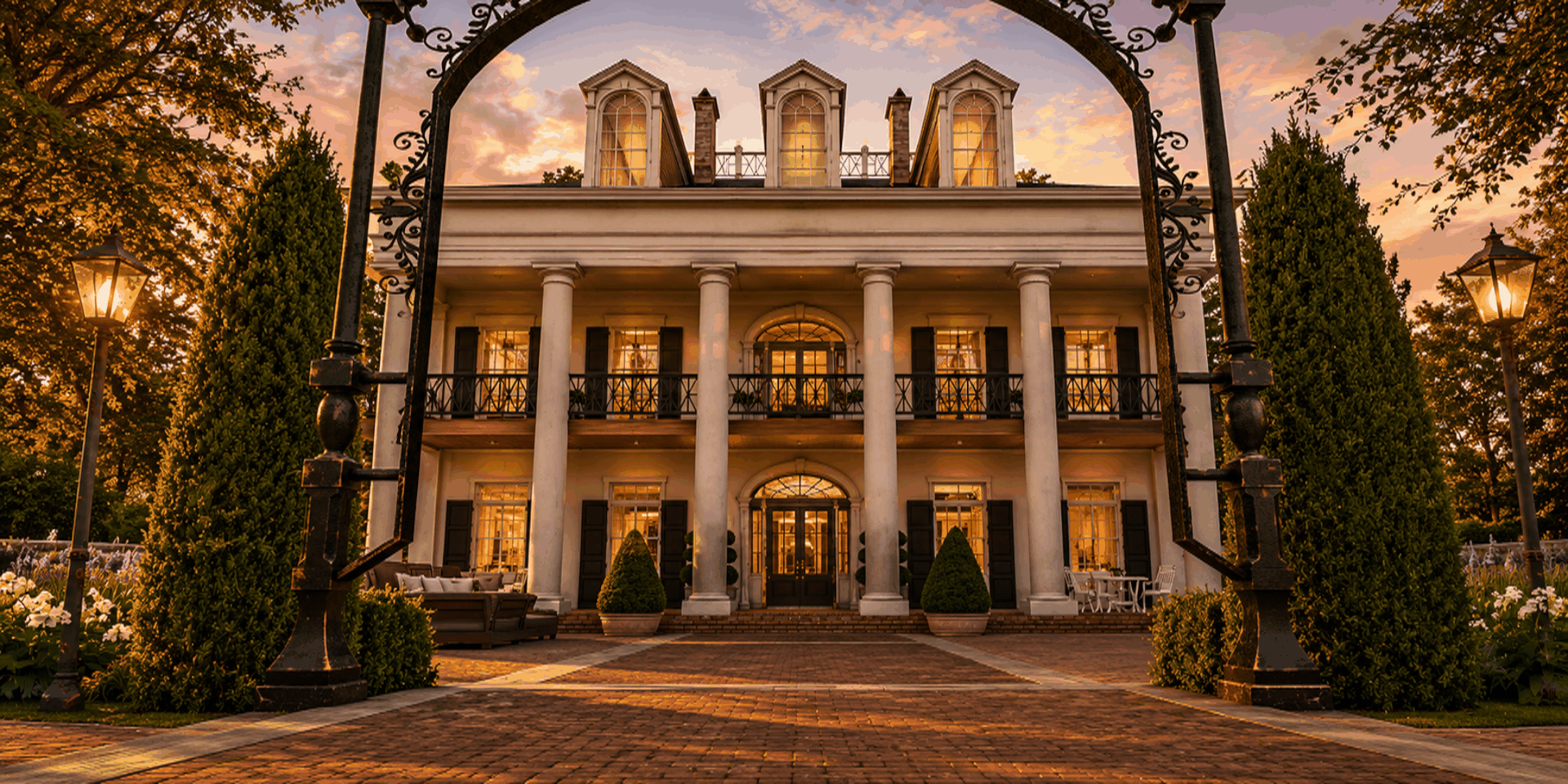
The house is best understood as a frontier interpretation of Second Empire domestic architecture, softened by Neoclassical and Italianate influences. Its most recognizable feature is the mansard roof with tall dormer windows, giving the upper floor a formal and imposing presence. The front elevation is symmetrical, with a broad central entrance, full-height columns, shuttered windows, and a deep balcony that gives the building the character of a private estate rather than a simple timber-town residence.
Unlike Hartwell Manor, which was built to project industrial power and old-world permanence, the Ashton Residence was more domestic in purpose. It was large, formal, and carefully arranged, but it was not intended to rival Hartwell’s seat of authority. Its grandeur was family-oriented rather than corporate. The house presented the Ashtons as disciplined, respectable, and established, without placing Clarence in direct architectural competition with Elias Hartwell.
The property included formal garden space, a carriage approach, service areas, and later outbuildings. Over time, its grounds became increasingly tied to the visual landscape of Oakridge, especially after the college expanded around the former Hartwell estate.
Proximity to Hartwell Manor
The Ashton Residence stands within close proximity to Hartwell Manor, near enough that the two houses have often been discussed together in local histories. This closeness was not accidental. Clarence Ashton’s professional life was tied directly to Hartwell Timber Company, and the residence’s location reflected his position within the company’s inner circle.
The house was close enough to Hartwell Manor to suggest access and importance, but far enough away to preserve a separate family identity. In the old Hartwell years, this placement would have been understood immediately. Hartwell Manor represented ownership and command. The Ashton Residence represented trusted management, order, and the machinery that made Hartwell’s ambitions workable.
That relationship shaped how the house was remembered. Even after Hartwell Timber declined, the Ashton Residence remained tied to the legacy of the company, not because it was a mill, office, or camp building, but because it embodied the respectable domestic face of the system that had helped transform Briarmont.
Inheritance by Ward Ashton
Clarence Ashton died on October 17th, 1916. Though his younger brother Edmund Ashton was still living, Clarence left the Ashton Residence and its remaining Briarmont holdings to his nephew Ward Ashton, then sixteen years old. Because Ward was not yet of age, the property was placed in trust until he could legally assume control.
The decision caused quiet tension within the family. Edmund was Clarence’s brother, but Clarence had always regarded him as the younger child of the family rather than the future. Ward represented the next generation, and Clarence appears to have believed that the house should pass forward rather than sideways.
A frequently cited passage from Clarence’s will reads:
“I leave the Ashton residence at Briarmont, with its grounds, records, and appurtenances, to my nephew Ward Ashton, to be held for him until such time as he may lawfully receive it. Let the house pass not merely as property, but as the charge of a family name. What was built by one generation must be answered for by the next.”|Clarence Ashton — Will & Testament
For Ward, the inheritance was not simply a gift. It was a burden attached to a name already complicated by the Ashton family’s connection to Hartwell Timber. Ward would later study at the Oakridge Institute of Forestry and Land Sciences, the very institution founded to examine and repair the environmental damage left behind by Hartwell’s era. This made his ownership of the house deeply symbolic. He had inherited a family residence built from the wealth and authority of the timber years while working alongside those trying to understand the cost of that history.
Decline After Edmund Ashton’s Death
Edmund Ashton died in 1928. After his death, the Ashton Residence entered a period of gradual decline. Ward maintained the property well enough to prevent it from collapsing, but he did not restore it as a family monument. Several rooms were closed off, portions of the garden became overgrown, and the house took on the character of a place preserved out of obligation rather than affection.
This period is important in the building’s history because it shows Ward’s unresolved relationship with the Ashton legacy. He did not abandon the residence, but neither did he fully claim it. The house remained standing, occupied at times and maintained in practical terms, but it no longer functioned as the confident family seat Clarence had intended it to be.
Donation to Oakridge College
In 1948, after the Oakridge Institute completed its transition into an accredited college, Ward Ashton donated the Ashton Residence to Oakridge. The donation marked the end of the building’s role as a private Ashton family house.
The transfer was widely interpreted as one of Ward’s defining civic acts. Rather than sell the property or preserve it as a family shrine, he gave it to the institution most closely associated with Briarmont’s restoration, research, and long-term stewardship. In doing so, Ward redirected the house from private legacy to public use.
A commemorative plaque was installed in 1949 near the main entrance. The plaque identified Ward Ashton as the donor and recognized the building’s conversion into an Oakridge College property. Its wording emphasized continuity, Education, and public purpose, reflecting Ward’s belief that inherited property should serve the future rather than merely preserve the past.
Renovations and Controversy
By the 1970s, Oakridge’s student population had grown, and the college began a major renovation program to adapt the Ashton Residence for expanded student use. These renovations included internal restructuring, the addition of new rooms, modern utilities, and modifications to the building’s upper floors. The most controversial addition was the construction of a swimming pool on the grounds.
The pool became a flashpoint almost immediately. Supporters argued that the residence needed to serve living students, not remain frozen as a museum piece. Opponents, including historians, preservationists, alumni, and many students, argued that the renovations compromised the integrity of one of Briarmont’s most important surviving 19th-century houses. The pool, in particular, was criticized as an intrusive addition that altered the character of the historic grounds.
Petitions circulated throughout Briarmont and Oakridge. Protests were organized by students and local preservation advocates, many of whom believed the college had moved too aggressively in modernizing the property. The controversy became one of the major local preservation debates of the decade.
In 1976, following sustained public pressure, the Ashton Residence was declared a historical landmark. The designation did not undo all of the changes made to the property, but it placed stronger limits on future alterations and formally recognized the building’s architectural and historical significance.
Modern Use
Today, the Ashton Residence serves as both a dormitory and student activity center for Oakridge College. Its rooms have been adapted for residential life, meetings, informal gatherings, student programming, and campus events. Though no longer a private family home, the building remains one of the most recognizable structures on campus.
Its modern role reflects the layered history of Oakridge itself. The Ashton Residence began as a statement of family respectability during the timber years. It became an inheritance shaped by guilt, duty, and unresolved memory. It was later given to Oakridge as an act of public redirection, then altered and contested as the college grew.
In its present form, the house is neither an untouched relic nor an ordinary campus building. It remains a living part of Oakridge: historic, imperfect, useful, and still carrying the weight of the family name that built it.
Location: The Ashton Residence