
 | |
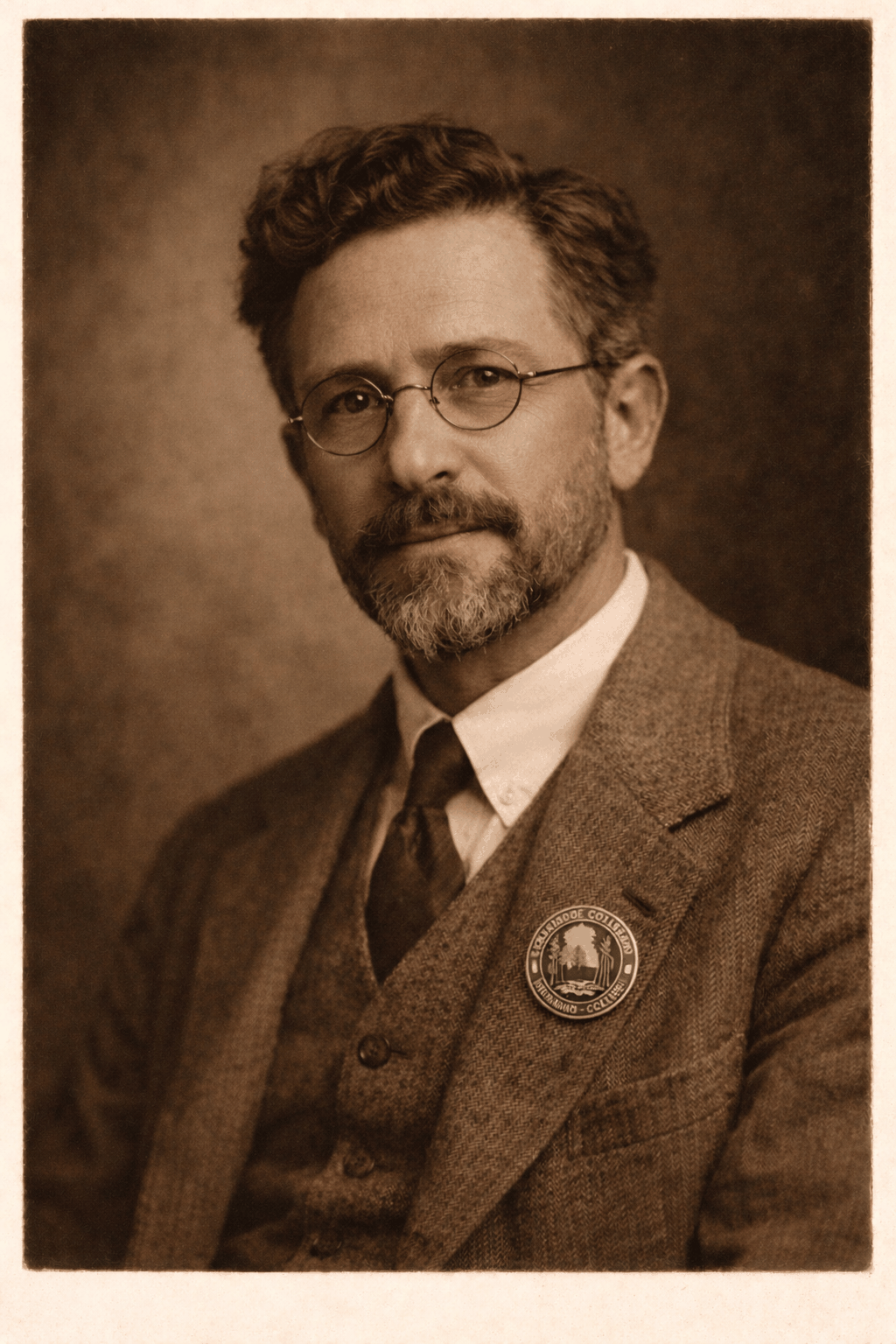
| Theodore Crenshaw | |
| Born | 1872 |
|---|---|
| Died | 1949 |
| Gender | Male |
| Organization | Oakridge College |
| Organizations | Oakridge Institute of Forestry and Land Sciences |
Overview
Professor Theodore Crenshaw was the first head researcher brought to Briarmont in the founding years of Oakridge Institute of Forestry and Land Sciences. Not a local man but a London-trained botanist and restoration specialist, Crenshaw arrived in 1918 as part of the Briarmont trust’s effort to give the new institute intellectual seriousness, practical credibility, and a discipline equal to the damage the region had endured. Where Hartwell’s generation had looked at land as a resource, Crenshaw belonged to a newer school of thought. He believed damaged ground could be studied, stabilized, and, with patience, taught how to live again.
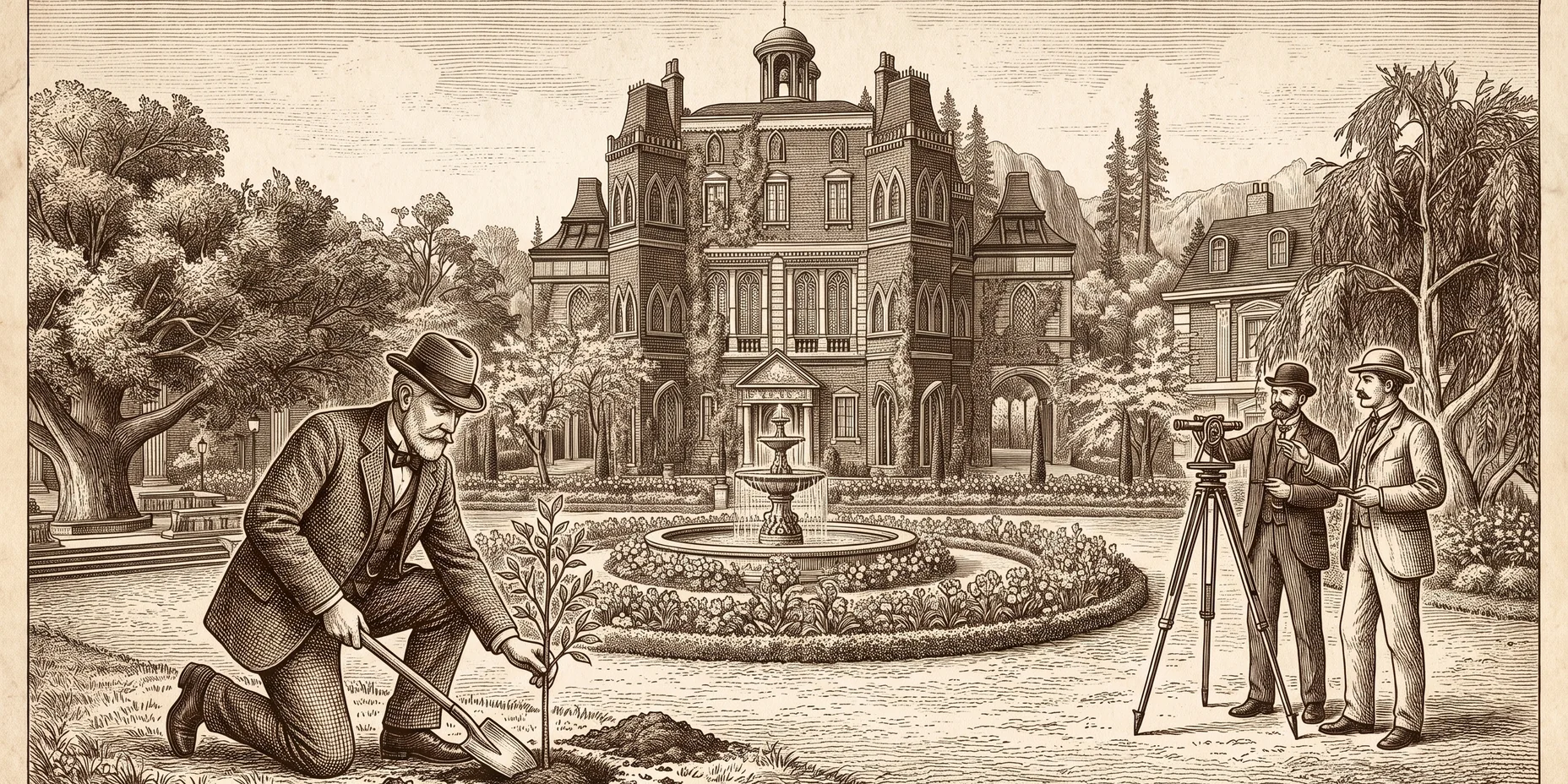
He is remembered in Oakridge history not as a charismatic founder in the popular sense, but as a man of method, reserve, and exacting standards. His influence on the institute’s early identity was profound. He helped establish its scientific character, shaped its first restoration priorities, and insisted from the beginning that Briarmont’s future could not be separated from the condition of its hillsides, waterways, and surviving forests. The ceremonial planting of the town oak in 1918 is most often attributed to him.
Background
Theodore Crenshaw was born in London in the late nineteenth century, likely in the 1870s, into a professional household that valued education, restraint, and public respectability. He came of age in a city that had long since become synonymous with industry, density, smoke, and social contrast. Yet it was not London’s power that most marked him. It was its strain. He developed an early interest in the relationship between human settlement and exhausted land, especially in the uneven borderlands between civic order and neglect: public gardens gone to ruin, churchyards left hard-packed and joyless, and parcels of urban ground too damaged or disregarded to be seen as beautiful until someone made the case that they still mattered.
He studied botany and plant sciences in London and later broadened that training into soils, drainage, and restoration planting. He was never merely a collector of specimens. He was practical by temperament and suspicious of ornamental theory untested by weather, use, and time. In the years before Briarmont, he gained a modest but serious reputation through his work advising on the reclamation and improvement of neglected green spaces in and around London. He argued that planting should not be treated as decoration alone. For Crenshaw, vegetation could stabilize slopes, cool streets, improve air, hold water, and alter the morale of a place as surely as stone, brick, or law.
He published occasionally, lectured when required, and became known among reform-minded academic and municipal circles as a man with little patience for vanity and considerable patience for slow results.
Arrival in Briarmont
By the mid-1910s, Briarmont and the surrounding region had begun to reckon more openly with the long damage left by Hartwell’s timber operations. The land above town had been eroded and destabilized, the watersheds degraded, and the surviving old-growth stands in the upper ridges had become all the more valuable because so much else had been lost. When Oakridge Institute of Forestry and Land Sciences was established in 1918, it was founded with a practical mission rooted in stewardship, ecology, recovery, and the serious study of land under pressure.
Crenshaw was recruited precisely because he was not local.
The Briarmont trust needed someone who had not grown up under Hartwell’s shadow, someone whose reputation rested neither on lumber nor on old loyalties, and someone capable of giving the institute an identity that looked forward rather than backward. Crenshaw’s work in London, though different in scale, recommended him as a scholar of disturbed ground and managed recovery. He understood what it meant to inherit damage. More importantly, he understood that restoration was not sentiment. It was labor, observation, and discipline.
He arrived in Briarmont to find something larger and stranger than anything England had prepared him for. London had taught him exhausted soil and crowded air. Northern California taught him scale. The redwoods unsettled him at first. Their height, their silence, and the sheer age implied by their presence stood far outside the cultivated botanical order in which he had been trained. If London had made him rigorous, Briarmont made him humble.
Work at Oakridge
Crenshaw’s early years at Oakridge were consumed by the task of making the institute real.
He helped organize its first field priorities around exactly the concerns that had driven its founding: slope stability, soil loss, watershed recovery, regeneration after clear-cutting, and the comparison between damaged lowlands and the surviving old-growth ecosystems in the upper mountains. Under his guidance, Oakridge did not become a finishing school for gentlemen foresters or a decorative naturalist society. It became a working research institution with mud on its boots and ledgers full of measurements. That emphasis fit Oakridge’s broader identity from the beginning, as the institute’s early work centered on ecology, forestry, surveying, and the direct study of recovery in the land around Briarmont.
Crenshaw was particularly drawn to three questions.
First, how quickly damaged ground could be made stable enough to support long-term regrowth.
Second, which species were best suited not merely to survive but to prepare the land for more complex recovery later.
Third, whether human intervention could be disciplined enough not to repeat the arrogance that had caused the damage in the first place.
He preferred field notes to speeches, disliked overstated claims, and insisted his researchers distinguish carefully between what had recovered, what had merely recolonized, and what remained fundamentally wounded beneath surface appearances.
Students and junior researchers remembered him as formal, observant, and difficult to impress. He was not cruel, but he could be cutting when presented with sloppy reasoning or theatrical idealism. At the same time, those who worked closely with him often came away fiercely loyal. He demanded seriousness because he believed the land required it. In that, many found him severe but trustworthy.
The Town Oak
Local tradition most often credits Theodore Crenshaw with the planting of the great oak in the center of Briarmont in 1918.
Whether the planting was entirely his idea or the result of a broader civic ceremony is less certain than later memory likes to pretend. What is clear is that the gesture aligned perfectly with his beliefs. He understood symbols, though he distrusted empty ones. To plant a tree in the center of town in the year Oakridge was founded was to make an argument in living form: that Briarmont’s future would not be built only from what it could take, but also from what it was willing to restore, protect, and patiently grow.
Crenshaw is said to have chosen the site because it stood at a meaningful intersection between the civic town, the memory of industry, and the future authority of the institute. In later decades, the tree would acquire a life in local memory far beyond its original planting. But in Crenshaw’s hands, it began as something disciplined and deliberate: a public marker of continuity, stewardship, and confidence without triumphalism.
Character
Theodore Crenshaw was not beloved in the easy way some public men are beloved. He was too reserved for that, and too disinclined to flatter. He had the manners of a well-brought-up English academic and the instincts of a field man who had learned to respect weather more than committees.
He dressed carefully, spoke precisely, and wasted neither words nor gestures. He could come across as cold to those who met him only briefly. In truth, he was guarded rather than unfeeling. He distrusted sentiment offered too quickly, praise too easily won, and certainty not earned by study. Yet he was not without warmth. It simply emerged in less obvious forms: in the patience with which he revised a student’s field notes, in the quiet defense of unpopular but sound research, or in the unusual care he showed living systems that too many others regarded as background.
He had a particular tenderness for hardy plants, marginal ground, and things dismissed as unsightly until they proved their use.
Legacy
Crenshaw’s greatest contribution to Briarmont was not a single paper, planting, or public gesture. It was the tone he set.
He helped establish Oakridge as an institution that took land seriously: not romantically, not commercially, but seriously. In a town shaped by extraction, that mattered. He gave intellectual backbone to the idea that damaged places deserved more than nostalgia or profit. They deserved study, stewardship, and honesty.
Later generations at Oakridge would broaden the college’s scope into the arts, humanities, and coastal sciences, but its foundational orientation toward place, restoration, and long-view stewardship remained deeply Crenshawian in character.
In modern Briarmont, his name endures most visibly in the tree and the street. Fewer residents know the details of his London life or his field methods. Fewer still could quote his work. But the shape of his influence remains. It is there in the old town oak, in Oakridge’s archival habits, in the instinct to ask what a landscape once was before deciding what it ought to become, and in the lingering belief that the land remembers both injury and care.
Retirement and Final Years
By the mid-1940s, Theodore Crenshaw had become inseparable from Oakridge’s founding identity, but also increasingly out of step with the direction the institution was taking. The Oakridge Institute had been established in 1918 as a place of practical, land-based study, shaped by restoration, forestry, ecology, and long field work in the shadow of Hartwell’s damage. Over time, however, Oakridge broadened beyond its original scientific mission and moved toward becoming a fuller academic institution. When that transition culminated in accreditation and the formal emergence of Oakridge College, Crenshaw stepped aside from active leadership and allowed a younger, more administrative figure to take the helm. Oakridge’s shift from a rigorous research institute into a broader college made his retirement feel not merely inevitable, but symbolic: the end of the founding era itself.
His successor, Arthur Bellamy, represented everything Crenshaw did not. Where Crenshaw was gentle, patient, and quietly principled, Bellamy was ambitious, competitive, polished, and keenly aware of appearances. Crenshaw’s manner, his sensitivity, his devotion to the land, and his easy rapport with Briarmont’s women all marked him, in Bellamy’s eyes, as soft, eccentric, and insufficiently suited to the harder, more modern institution Bellamy intended to build. Bellamy understood Oakridge as something to be disciplined, expanded, and made respectable. Crenshaw had always understood it as something to be tended.
Though retired from leadership, Crenshaw did not withdraw from Briarmont. If anything, he became more fully a local figure than an institutional one. He continued to care for the oak he had planted in 1918, treating it not as a ceremonial object but as a living expression of the work he had devoted his life to. He remained warmly regarded by townspeople, especially by the women of Briarmont, many of whom admired the unusual combination of intellect, gentleness, and moral steadiness he embodied. He also maintained friendly ties with The Briarmont Yarrow League, supporting its gardening efforts, preservationist instincts, and wider civic care for the town’s landscape and memory. In this later chapter of his life, Crenshaw came to stand for something larger than Oakridge itself: not power, but stewardship; not ambition, but continuity.
This only sharpened Bellamy’s private resentment. Bellamy could command authority, but not affection. He could modernize Oakridge, but he could not replace what Crenshaw meant to Briarmont. To many, the contrast between them became obvious. Bellamy was the future of the college. Crenshaw remained its conscience.