

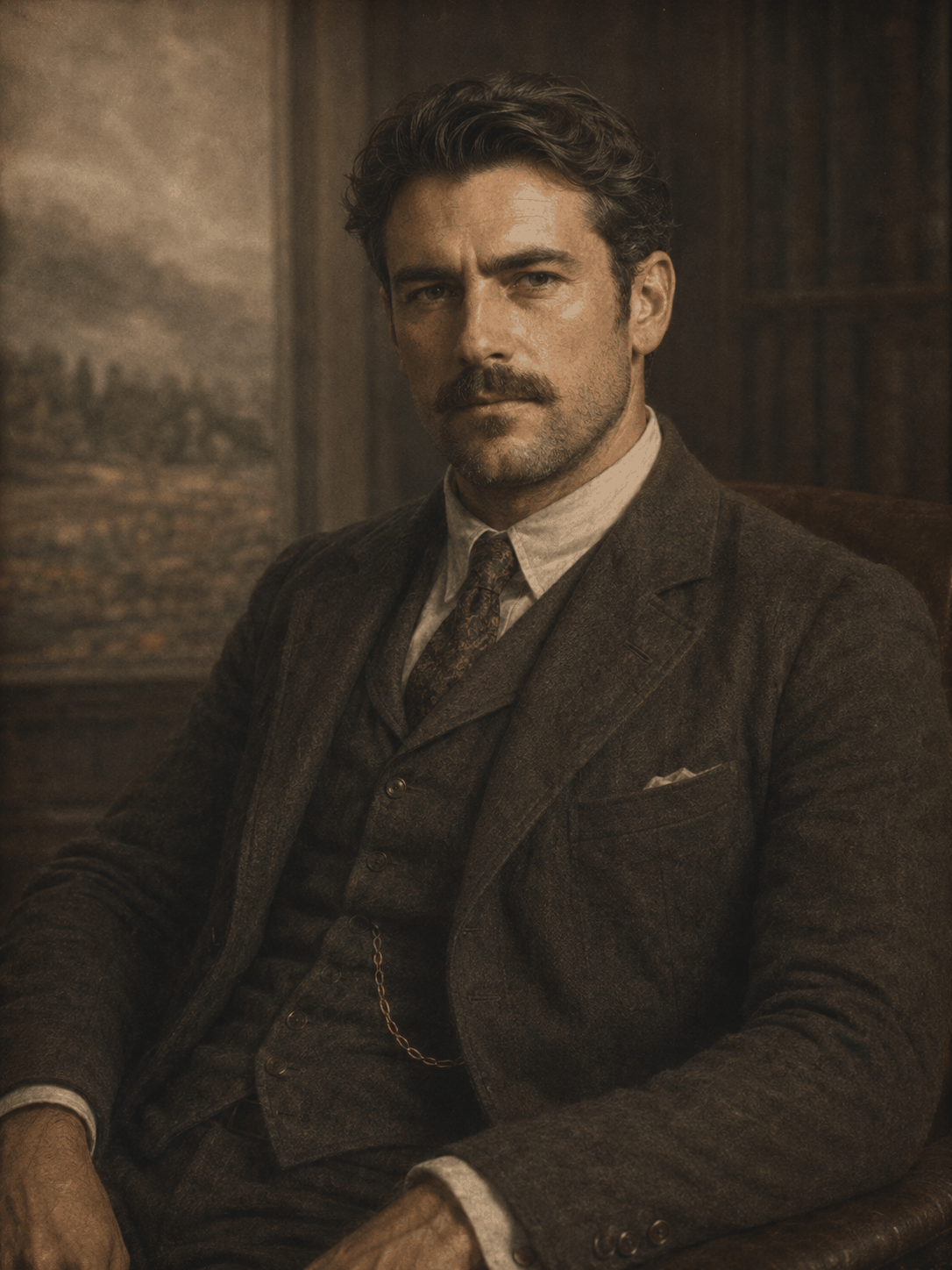
 | |
| Benedict Ellery Ashton | |
| Born | April 14th, 1882 |
|---|---|
| Birthplace | Briarmont, CA |
| Died | April 22nd, 1949 |
| Place of death | Briarmont, CA |
| Spouse | Clara Siswaqi' Ashton |
| Parents | Clarence Ashton Margaret Ellery Ashton |
| Gender | Male |
| Eyes | Brown |
| Hair | Dark Brown |
| Height | 5'10" |
Overview
Benedict Ellery Ashton was the only son of Clarence Ashton, though later Ashton family histories often reduced him to a quiet omission. Gentle, introverted, and drawn more to writing and the natural world than to timber, engineering, or company management, Benedict never became the heir Clarence wanted. As a child, he watched the forests disappear and the land erode, but learned early that grief over such things had no place in his father’s house. His marriage to Clara Siswaqi’, a Wiyot woman, deepened the break between father and son, and his failed attempts as a writer did little to restore Clarence’s regard. When Clarence left the Ashton Residence to Ward instead of Benedict, the decision publicly confirmed a rejection that had shaped Benedict’s entire life. His later challenge to the will failed, leaving him remembered less as Clarence’s son than as one of the first Ashtons deliberately written out of the family’s preferred history.
Early Life
Benedict Ellery Ashton was born on April 14th, 1882, the only son of Clarence Ashton. His birth came late in Clarence’s life, at a time when the Ashton name was already bound tightly to Hartwell Timber Company, Briarmont’s expanding economy, and the damage left behind by decades of extraction.
From an early age, Benedict proved unlike the son Clarence had expected. He was quiet, observant, and inwardly sensitive, with little interest in timber operations, engineering, accounts, or the management of men. Where Clarence valued discipline, command, and usefulness, Benedict was drawn to books, stories, weather, birds, creeks, and the slow life of the forest. He noticed the land carefully, not as a resource to be measured and taken, but as something living that changed under pressure.
As a child, Benedict watched trees disappear from the hills around Briarmont and saw the land begin to suffer from what Hartwell Timber had taken. He understood loss before he had the language for it. Yet he rarely voiced that grief. In Clarence Ashton’s household, sorrow over felled trees, eroded slopes, or damaged waterways had no proper place. Such feelings were treated as softness, and softness was not encouraged.
Benedict’s school years did little to strengthen him in his father’s eyes. He was often bullied by other boys, who mistook his quietness for weakness and his gentleness for something shameful. He did not fight easily, did not boast, and did not seem eager to prove himself through the rougher forms of boyhood expected in Briarmont. Clarence responded not with protection, but with disappointment. To him, Benedict’s reserve was not a temperament. It was a failure of formation.
The distance between father and son only deepened as Benedict grew older. Clarence often ignored him, corrected him coldly, or treated him as a problem that time might solve. Benedict learned to make himself less visible in the house, retreating into books, private sketches, and early attempts at writing. His imagination became the one place where Clarence’s expectations could not fully reach him.
When Ward Ashton was born in 1900, Benedict’s place in the family became even more uncertain. Ward was Clarence’s nephew, not his son, but Clarence increasingly regarded him as the future of the Ashton name. Benedict, already eighteen years old and expected to begin making something of himself, saw his younger cousin drawn into the attention he had never been able to earn.
Education
Benedict Ellery Ashton was educated in Briarmont according to the expectations placed upon an Ashton son. His schooling included the usual instruction in mathematics, accounts, practical writing, and the principles of business and land management. Clarence Ashton appears to have expected this education to prepare Benedict for some useful role within the family’s commercial affairs, but Benedict showed little lasting interest in timber operations, engineering, or company administration.
By his late teens, Benedict had become more closely drawn to the offices of The Ridgeline, Briarmont’s local newspaper. There, he developed an interest in printing work and the mechanics of publication. He spent time in the paper’s printing facilities, learning type-setting, page preparation, press maintenance, and the practical labor required to turn local events into public record.
The work suited him more than the timber trade ever had. Printing offered Benedict a disciplined craft that still allowed room for language, observation, and story. His time around the press also shaped his understanding of Briarmont itself: what the town chose to publish, what it softened, and what it left unsaid.
Though Clarence never regarded newspaper work as a proper future for his son, Benedict’s experience at The Ridgeline became central to his later writing life. It gave him both a trade and a view of history as something made by human hands, arranged in columns, printed in ink, and preserved only when someone decided it was worth recording.
Career / Employment
Printing Room Apprentice, The Ridgeline
1898–1902
Benedict Ellery Ashton began working around the printing facilities of The Ridgeline in his late teens. At first, his duties were modest: carrying copy, sorting type, cleaning equipment, preparing paper, and assisting older printers with the physical labor of publication. The work introduced him to the mechanics of print and gave him his first sustained contact with Briarmont’s public record.
Compositor and Pressman, The Ridgeline
1902–1907
By his early twenties, Benedict had become a more regular presence in the paper’s printing room. He learned type-setting, page arrangement, press operation, and basic maintenance. Though Clarence Ashton never considered newspaper work a suitable future for his son, Benedict found meaning in the craft. Printing allowed him to work with machinery without entering the timber trade, and with language without depending entirely on literary success.
Printer and Occasional Contributor, The Ridgeline
1907–1916
After marrying Clara Siswaqi’ in 1907 and leaving the Ashton household, Benedict continued working in and around the local press. During this period, he began placing short pieces, sketches, and unsigned or lightly attributed items in local publication. His work often focused on landscape, domestic tension, memory, and the quiet costs of Briarmont’s growth. None of it brought him significant recognition, but it marked the beginning of his life as a writer.
Independent Writer and Job Printer
1916–1932
Following Clarence Ashton’s death and the failed dispute over the Ashton Residence, Benedict worked more independently. He took small printing jobs, assisted with notices and private documents, and continued writing short stories. Some pieces were submitted to regional papers and literary magazines, with limited success. His writing from this period is often considered his most personal, shaped by estrangement, fatherhood, and his growing awareness that the Ashton family had chosen to remember itself without him.
Local Essayist and Private Writer
1932–1949
In later life, Benedict withdrew from regular public work but continued writing privately. He produced essays, fragments, nature sketches, and unfinished stories, many of which dealt indirectly with inheritance, erased histories, damaged land, and families that mistook silence for dignity. Though he never became a successful author in his lifetime, his surviving papers later became important to those trying to understand the Ashton family from outside its official version of events.
Personality
Benedict Ellery Ashton was remembered as a quiet, gentle, and inwardly observant man. Unlike Clarence Ashton, who valued command, discipline, and public usefulness, Benedict was more reflective than forceful. He preferred written language, natural places, and private thought to business negotiation or social display.
Those who knew him described him as polite but reserved. He was not unfriendly, but he rarely imposed himself on a room and often seemed more comfortable listening than speaking. This reserve was sometimes mistaken for weakness, particularly by those who measured character by confidence, ambition, or physical assertiveness.
Benedict had a strong sensitivity to place. He noticed weather, trees, water, erosion, birds, and small changes in the landscape with unusual care. This attentiveness shaped both his writing and his private grief over Briarmont’s damaged hillsides and waterways, though much of what he felt remained unspoken.
His gentleness did not mean he lacked conviction. Benedict could be stubborn in quiet ways, particularly when pushed beyond endurance. His marriage to Clara Siswaqi’ was one of the clearest examples of this. Though he spent much of his life being overlooked or dismissed, he was capable of decisive action when the matter touched his deepest loyalties.
Legacy
Benedict Ellery Ashton’s legacy remained uncertain for much of Briarmont’s history. In official Ashton family accounts, he was often mentioned only in passing, if at all. His failed challenge to Clarence Ashton’s will, his marriage to Clara Siswaqi’, and his quiet life as a writer did not fit comfortably within the family’s preferred image of inheritance, duty, and respectability.
For many years, Benedict was remembered less for what he did than for what had been denied to him. He was Clarence Ashton’s only son, yet the Ashton Residence passed to Ward Ashton instead. This omission shaped how later generations understood the family, though public histories often softened the matter into a simpler story about Clarence choosing the next generation over his younger brother Edmund.
Benedict’s writing gave his life a quieter form of endurance. Though he never achieved the literary success he hoped for, his stories and fragments preserved a more private Briarmont: damaged hillsides, uneasy households, old griefs, and people who lived in the shadow of stronger names. Later readers would come to see his work as one of the earliest Ashton attempts to record what the family itself preferred not to say.
His death in 1949, shortly after learning that Ward had planned to give the Ashton Residence to Oakridge College and left Briarmont, deepened the tragedy of his place in the family history. To Ward, the donation was release. To Benedict, it was the final proof that the house would never return to Clarence’s own line.
Benedict is now remembered as one of the most quietly consequential figures in the Ashton family: not an heir, not a patriarch, and not a public reformer, but a man whose exclusion revealed the cost of Clarence Ashton’s control. His life exposed the silence beneath the Ashton legacy and made clear that inheritance is not only about property. It is also about recognition, memory, and who a family chooses to erase.
Credits
Written by: Charles Fairweather