

 | |
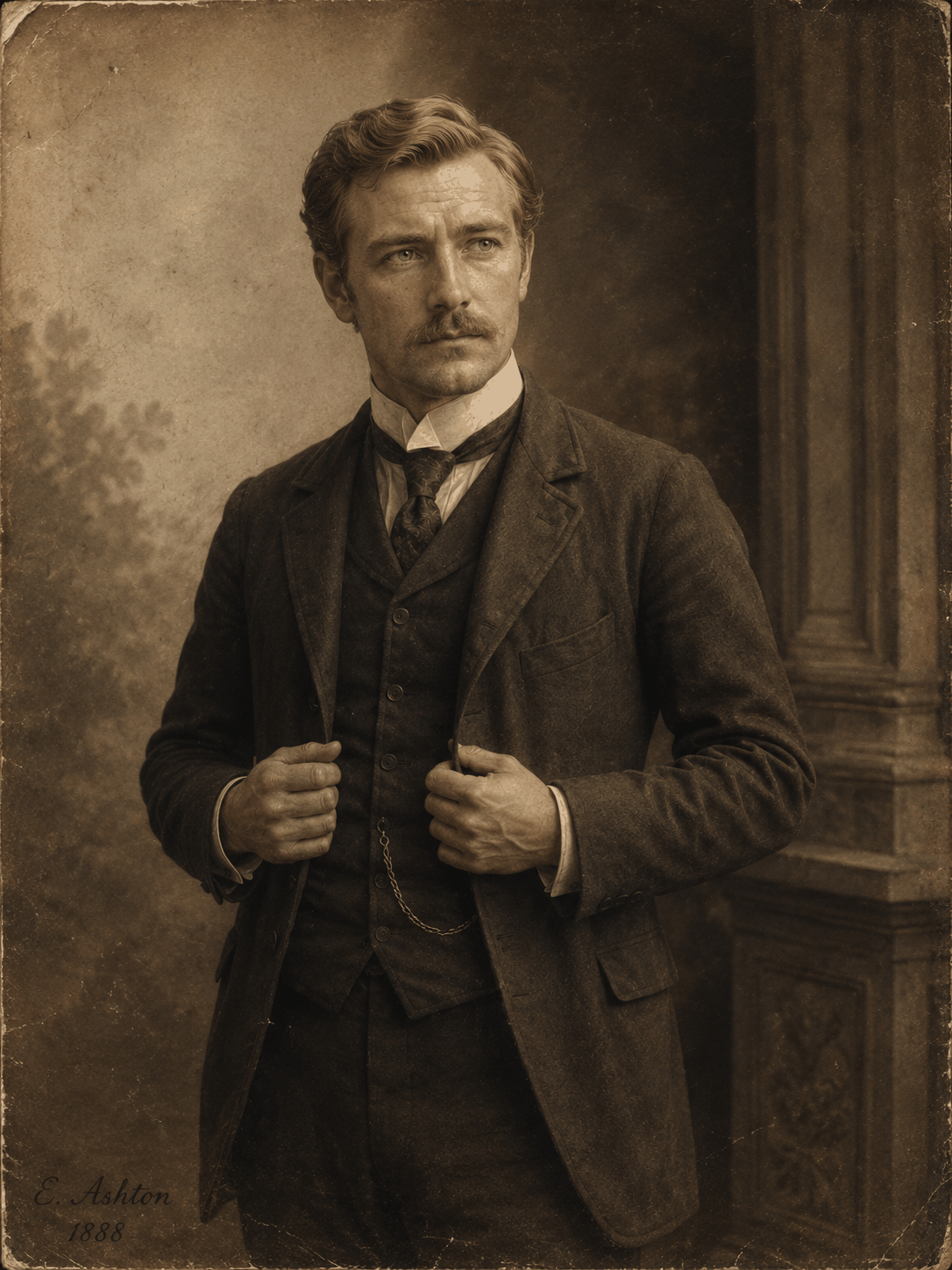
| Edmund Ashton | |
| Born | September 4th, 1850 |
|---|---|
| Birthplace | Briarmont, CA |
| Died | February 12th, 1928 |
| Place of death | The Ashton Residence |
| Parents | Samuel Ashton Rebecca Hale Ashton |
| Siblings | Clarence Ashton |
| Spouse | Eliza Harrow Ashton |
| Children | Ward Ashton |
| Gender | Male |
| Eyes | Blue |
| Hair | Dark Brown |
| Height | 5'7" |
| Affiliations | The Ashton Family |
Edmund Ashton (1850–1928) was a son of Samuel Ashton and the younger brother of Clarence Ashton, the Ashton who ran the Hartwell Timber Co. He married Eliza Harrow Ashton and was the father of Ward Ashton.
A quiet life at the Residence
Edmund lived out his life at the Ashton Residence, the house his brother Clarence had built. When Clarence died in 1916, the Residence and the family holdings passed not to Edmund — his living younger brother — but over him to Clarence’s sixteen-year-old nephew Ward, whom Clarence’s will named to carry the Ashton name. Edmund remained in the house until his death on February 12, 1928.
Early Life
Edmund Ashton was born on September 4th, 1850, in the Ashton family home on the property where the Ashton Residence would later stand. He was an unexpected late child, born nearly twenty-one years after his older brother Clarence. By then, the family’s circumstances had changed considerably. The harshest years of frontier survival were behind them, Clarence’s position under Elias Hartwell had brought greater comfort and security, and Samuel and Rebecca Ashton finally had time to give a child the affection and attention that necessity had often denied their eldest son.
Clarence never forgot the difference. He had grown up when every pair of hands was needed and tenderness was a luxury easily postponed. Edmund, by contrast, was allowed to remain young. He was indulged, protected, and given considerable freedom, which Clarence interpreted as softness. He often called him “Little Eddie,” sometimes with the toleration of an older brother, but more often as a reminder that he did not regard Edmund as a serious man or a true representative of the Ashton family.
Because Edmund was neither expected to inherit responsibility nor prepared for a defined profession, his future was left largely to chance. He was loved but seldom directed. Once his primary schooling ended, he began helping around the residence, working alongside servants and gardeners before seeking employment elsewhere in Briarmont.
Education
Briarmont Common School
1857–1863
Received a basic primary education in reading, writing, arithmetic, geography, history, and penmanship. His attendance was adequate but his studies were not treated as preparation for leadership, business, or advanced schooling.
Informal Household and Grounds Training
1863–1866
Worked alongside the servants and gardeners of the Ashton household. Learned basic gardening, household maintenance, tool care, parcel handling, and the practical routines required to maintain a large residence and its grounds.
Practical Harbor Instruction
1866–1868
Learned freight handling, dock safety, cargo identification, tallying, and the movement of goods through informal work at Briarmont Harbor. His wages were initially paid privately and kept outside the formal books until he was old enough to obtain regular employment.
Postal Route and Sorting Training
1870–1873
Received practical instruction in mail sorting, delivery schedules, address records, parcel handling, and Briarmont’s expanding street and rural route system.
Career / Employment
Household and Grounds Assistant, Ashton Residence
1863–1866
Helped servants and gardeners maintain the family property after leaving school. His duties included carrying supplies, tending paths and beds, cleaning tools, assisting with repairs, and performing whatever small tasks were needed around the residence.
Informal Harbor Hand
1866–1868
At sixteen, Edmund was offered temporary work by one of Clarence’s associates at Briarmont Harbor. He loaded and unloaded parcels, luggage, mail sacks, and smaller cargo. He was paid off the books while gaining enough experience to secure formal work.
Porter, Briarmont Harbor
1868–1873
Worked regularly as a porter, carrying baggage, parcels, supplies, and personal effects between vessels, wagons, boarding houses, businesses, and private homes. His reliability and courteous manner made him familiar to residents throughout the growing town.
Postal Assistant
1873–1876
Recruited to assist Briarmont’s postal service as the town’s population and volume of correspondence increased. Sorted letters and parcels, maintained route lists, and helped established carriers with deliveries throughout town.
Mail Carrier / Postman
1876–1915
Became one of Briarmont’s best-known and most trusted postal workers. Residents recognized him by his brown moustache, warm blue eyes, and habit of stopping long enough to listen. Edmund carried more than letters; he helped with gates, packages, directions, small repairs, and household troubles whenever time permitted. By the time he met Eliza Harrow, he had earned a place in Briarmont through kindness rather than status.
Caretaker of the Ashton Residence
1917–1928
Managed and maintained the residence after Clarence left it to Ward Ashton. Although Ward wanted no part of the inheritance, Edmund accepted its practical burdens to protect his son from Clarence’s final attempt to shape his life. He oversaw the grounds, household repairs, accounts, and daily preservation of the property until his death.
Personality
Edmund Ashton was soft-spoken, gentle, and conscientious in nearly everything he did. He moved carefully through the world, aware of the people and circumstances around him, and rarely behaved as though his own concerns were the most important in the room. Childhood taught him to stay out of Clarence’s way, and that caution followed him into adulthood. He disliked confrontation, spoke modestly, and often yielded ground before an argument could begin.
He was naturally shy, though Eliza Harrow drew from him a courage that surprised even Edmund himself. He later claimed that she helped him discover a bravery he had always assumed belonged to harder men. His warmth was most visible in the time he gave others. Where Clarence measured usefulness through production, discipline, and results, Edmund believed there was always time for a conversation, a small kindness, or a person who needed help. This difference lay at the heart of their strained relationship.
Nothing mattered more to Edmund than his family. Eliza was the great love of his life, and Ward, born late in their marriage, was cherished with an almost reverent tenderness. When Ward inherited the Ashton Residence and immediately rejected the burden placed upon him, Edmund stepped between his son and Clarence’s intentions. He maintained the house so Ward would not have to surrender his youth to an inheritance built upon control. It was one of Edmund’s quietest acts of defiance: accepting the weight himself so his son might grow without becoming the man Clarence had tried to design.
Legacy
Edmund Ashton left behind no company, public monument, or fortune of his own. What remained after him was affection. For decades, he had walked Briarmont’s streets carrying its letters, learning its names, listening at its gates, and making people feel remembered. His legacy survived in the warm recognition of those who had known his footsteps and in the stories of small kindnesses that never entered official records.
Eliza died in February 1927. Edmund followed almost exactly one year later, on February 12th, 1928. Some believed he endured that final year because the Ashton Residence still depended upon his care. He continued tending its rooms and grounds even after the person who had made it feel like home was gone.
Edmund was found seated on a bench in the garden, with his gardening gloves and a hand basket of tools resting nearby. To anyone who had not known him, he appeared merely to have fallen asleep after a long morning’s work. To those who did, the manner of his death seemed entirely fitting. Edmund Ashton had spent his life quietly caring for people and places others overlooked, and he left the world in the same way: without spectacle, surrounded by the small work he had believed was always worth doing.