
 | |
| Gideon Rourke | |
| Born | 1834 |
|---|---|
| Died | 1890 |
| Gender | Male |
| Organization | Hartwell Timber Co. |
Overview
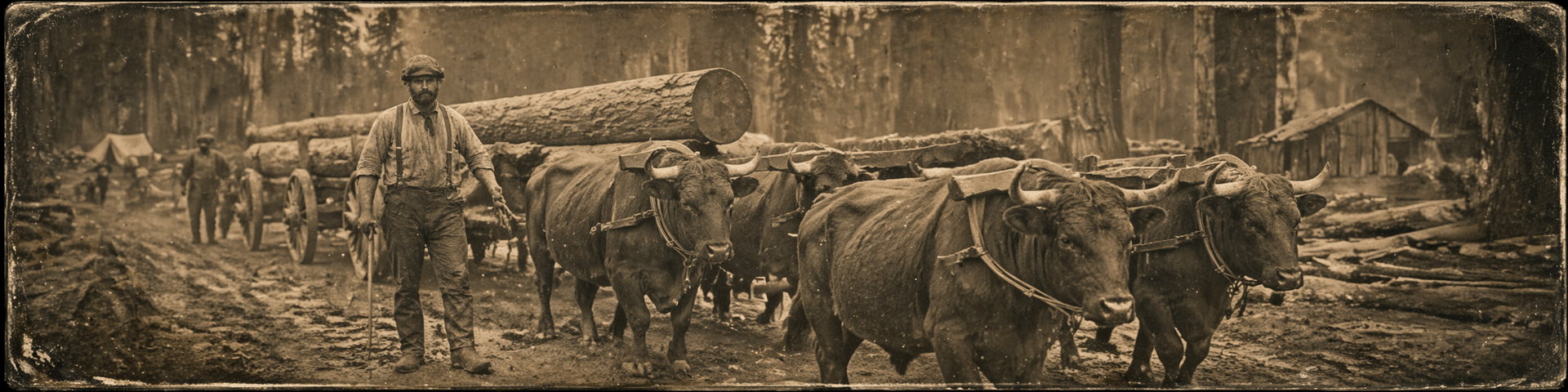
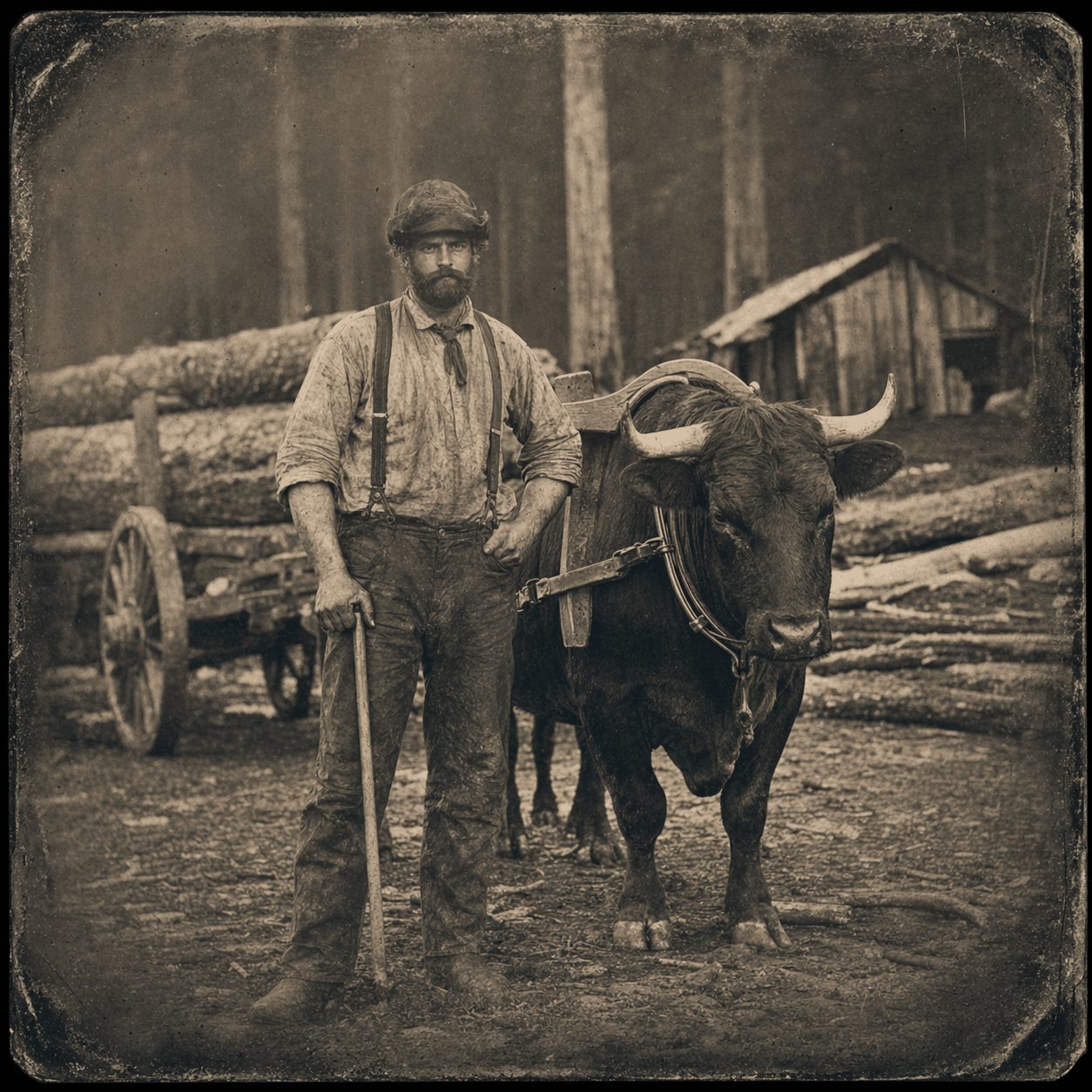
Gideon Rourke was Hartwell Timber Co.’s hauling foreman and ox-team lead, responsible for the brutal, necessary work of moving cut timber out of the forests and across the unstable ground around Briarmont. If other men found the trees, marked the routes, or brought the logs down, it was Gideon’s task to get them the rest of the way without losing animals, wagons, men, or time. In practical terms, that made him one of the most indispensable men in Hartwell’s early operations.
Irish by background and hard by temperament, Gideon was known for his sharp tongue, severe standards, and instinctive understanding of weight, balance, draft animals, and bad ground. He was not the sort of man people praised warmly, but he was the sort they listened to when things turned dangerous. He knew how deep a wheel would sink before the mud took it, how a slope would behave after rain, and how long a frightened ox would hold before panic ruined an entire haul.
Over time, his work made him one of the first men in Hartwell’s employ to understand, in blunt and material terms, that the land itself was beginning to fail under the company’s methods. He did not speak of that in academic language. He knew it because the roads got worse, the slopes less stable, the crossings more treacherous, and the loads harder to move with each passing year. The forest was not merely being cut. It was ceasing to hold.
Though practical to the bone, Gideon carried with him a strain of old Irish superstition that never entirely left him. He mocked ghost stories in company, but avoided certain stretches of woods after dark, watched the behavior of beasts more closely than the reassurances of men, and came to distrust some of the stranger figures in Hartwell’s orbit, especially Amos Pike. In that way, Gideon became one of those useful Briarmont men who stood with one boot in labor and the other in folklore, whether he liked it or not. Amos Pike later became the center of the town’s most enduring forest legend, while Nathaniel Vale’s disappearance would likewise be absorbed into Briarmont’s darker mythology.
By the late 1880s, years of hard labor, bitterness, and drink had hollowed him out. He died around 1890 after a long decline brought on by alcoholism, remembered in different ways depending on who told the story: as a bastard, as a brute, as the best hauling man Hartwell ever had, and as one of the few who heard the road break before everyone else did.
Before Hartwell Timber Co.
Gideon Rourke likely came west already shaped by hard movement, poor weather, and labor that depended on muscle, nerve, and the proper handling of animals. Whether he was born in Ireland or to Irish immigrants in America, he belonged to the broad and familiar 19th-century type of man produced by displacement, hunger, and rough work: not refined, not sentimental, but disciplined by necessity and suspicious of comfort.
Before arriving in Briarmont, Gideon is believed to have worked as a teamster, freight hand, or wagon driver along western routes tied to mining camps, construction, and inland supply movement. Such work would have made him useful almost anywhere in the American West, but especially in Northern California, where the terrain itself was often as great an obstacle as any distance. He learned to judge roads by smell and sound as much as by sight. He knew what wet clay did under the wheel. He knew what happened when a load shifted too fast downhill. He knew that draft animals were not machines, and that a good driver paid attention before they told him, in the only language they had, that they had reached their limit.
That background made him exactly the kind of man Hartwell needed in 1857, when the company was still small, and every successful haul mattered disproportionately. Hartwell Timber Co. began as an eight-man operation built to supply lumber for the expanding needs of the American West. A man who could get timber out of bad country without turning every trip into a catastrophe would have been worth more than many men with finer manners and better grammar.
Gideon was not drawn west by romance. He was drawn by work, and work answered.
Years Under Hartwell
From the beginning, Gideon’s importance lay not in visibility but in consequence. Trees could be felled, cut, and stacked, but until they were moved, they were not profitable. Hartwell’s growing enterprise depended on the constant movement of timber from forest to mill to transport. In that chain, Gideon occupied one of the most unforgiving links.
As hauling foreman and ox-team lead, he oversaw the men and animals charged with dragging immense loads across newly cut roads, muddy clearings, unstable slopes, and improvised routes through country that became more dangerous the more it was stripped. He would have been responsible for assigning teams, judging whether the ground could bear the load, deciding when to delay a haul after rain, managing the placement and balance of timber, and preventing drivers from killing men or beasts through carelessness. Hartwell Timber’s early success depended on all parts of the operation working in sequence, and Gideon’s portion of that work was among the least glamorous and most physically punishing.
He earned a reputation quickly.
Gideon was known as a hard man, and not unfairly. He had little patience for bravado, less for stupidity, and none at all for panic around animals. He was coarse in speech, sharp in correction, and fully capable of humiliating a man in front of others if he thought the lesson would stick. Yet even those who disliked him tended to admit that he was right more often than anyone wanted him to be. If Gideon said the road would not hold, men remembered it after it gave way. If he said an ox was spent, he was usually proved right before sundown. If he told a driver to cut loose a load or wait for the ground to dry, it was because he had already calculated the cost of ignoring him.
He trusted animals more than most people.
That fact became one of the more repeated details in later stories about him. Gideon was rough with men, but rarely needlessly cruel with oxen. He knew each team by temperament, endurance, and breaking point. He could read strain in a beast’s gait before another man noticed it. He was said to speak more gently to draft animals than to most of the workers under him, not because he was soft-hearted, but because animals did not lie, boast, or pretend to be stronger than they were.
As Hartwell’s operations expanded through the 1860s and 1870s, Gideon’s role became harder rather than easier. Hartwell’s crews cut aggressively, and the wider region began to show the consequences: erosion, unstable slopes, silted waterways, and a general deterioration of the land that sustained both labor and settlement. These larger effects are well established in Briarmont’s historical record. Gideon would not have described them in scientific terms, but he saw them all the same. He saw hillsides loosen after clearing. He saw creek crossings become unreliable. He saw familiar roads turn treacherous in wet seasons because the land no longer held the way it once had.
In that sense, Gideon became one of the first men in Hartwell’s orbit to understand decline as a daily physical reality. Nathaniel Vale saw what the forest was losing; Gideon saw what the company was doing to the ground beneath its own wheels. Nathaniel is remembered in later writing as one of the few men who loved the forest for more than what could be taken from it. Gideon, by contrast, did not love the forest. But he knew when it had stopped cooperating.
His relations with the other Hartwell men were likely uneven.
He probably respected Nathaniel Vale’s usefulness while distrusting the younger man’s attachment to the woods. Nathaniel knew the land by trail, water, and game. Gideon knew it by load, drag, and hazard. He almost certainly disliked Amos Pike, whose silence, strange habits, and reputation for appearing where no one had heard him approach would have unsettled a man already responsible for keeping frightened animals and dangerous hauls under control. Amos’s habit of startling men in camp might have been humorous to some, but to Gideon it would have looked like foolishness in a place where panic could get something crushed. Amos later became the center of The Ghost of Briarmont legend, precisely because that unsettling quality stayed with him in memory.
For all his practical nature, Gideon carried superstitions of his own. He did not advertise them, and would likely have denied them if mocked, but he was the sort of man who watched animals for warning signs, mistrusted certain silences, and believed some stretches of ground had a way of going bad beyond explanation. That made him one of the men best suited to feed Briarmont’s later folklore without ever intending to. A man like Gideon would not say he believed in ghosts. He would say only that there were places where no sensible driver hitched up after dark.
Decline and Death
Gideon’s decline was not sudden. It was the long, ugly erosion of a man worn down by labor that gave nothing back.
By the later years of Hartwell Timber’s strongest period, Gideon was already carrying more than routine fatigue. The work had become more dangerous as the ground worsened. The company demanded continued output from land that no longer supported it as readily. The men under him changed. The roads changed. The weather seemed to hit harder in places that had once been protected by denser forest. He became, by temperament and necessity, angrier, more suspicious, and less willing to soften his judgments for anyone’s pride.
Drink filled the rest.
Gideon had likely always been a drinking man to some degree; frontier labor culture did not discourage it, and hard liquor was as common a consolation as it was a vice. But what may once have been ordinary rough-company drinking seems to have deepened over the years into dependence. By the 1880s, he was known not merely as hard but as increasingly ruined by whiskey. The change showed in his temper first, then in his body. Men said he grew yellower in the face, more swollen in the middle, more easily exhausted, yet still stubborn enough to work longer than anyone thought wise.
By then, his reputation had shifted.
He was still the man people trusted when the haul turned bad, but he was also becoming one of those men whom younger workers regarded with a mixture of fear, irritation, and uneasy pity. He repeated himself more. His superstitions sharpened. Old warnings about bad roads and worse places began to sound, to some ears, less like seasoned judgment and more like the bitterness of a man who had seen too much and survived longer than it benefited him.
He died around 1890, likely from complications of alcoholism, after a period of visible physical decline. Cirrhosis would fit what later generations might have remembered as a wasting sickness brought on by drink. His death came before the final decades of Hartwell Timber’s decline were fully complete, but after he had already watched enough of the company’s trajectory to know where it was headed. By the time the environmental cost of Hartwell’s operations became publicly undeniable in the 1890s, Gideon had already spent years living with that knowledge in a more immediate and punishing way. Hartwell’s own legacy later became inseparable from the damage his operations left on the land.
Gideon did not live to see Hartwell die in 1911 or the estate become Oakridge in 1918, but the college’s eventual founding on land damaged by Hartwell’s methods gives his life a bitter kind of retrospective irony. Oakridge would later study watershed decline, erosion, and forest recovery in precisely the sort of landscape Gideon had been forced to work across while it was still being broken.
Legacy
Gideon Rourke left behind no grand legend in the manner of Amos Pike and no melancholy folklore in quite the way Nathaniel Vale did. Amos became The Ghost of Briarmont. Nathaniel became one of the men the forest never gave back. Gideon’s memory endured differently: in sayings, in work stories, in the rough respect reserved for men who were difficult to like and impossible to replace.
Among those who remembered Hartwell Timber in practical terms, Gideon was the man who knew bad ground before it failed. He became the sort of figure later generations summarized in lines rather than anecdotes. A road was unsafe because “Rourke would never have taken a team through there.” A young hauler was foolish because “he thought nerve mattered more than weight.” In that way, Gideon’s memory attached itself not to mystery but to judgment.
And yet, Briarmont being Briarmont, even judgment drifts toward folklore.
In later retellings, especially after the stories of Amos Pike and Nathaniel Vale settled deeper into local myth, Gideon was sometimes folded into their orbit as the practical man who sensed trouble first. He became the laboring witness who never said “ghost,” but refused certain places after dusk anyway. The man who watched the oxen balk and concluded that beasts knew something men did not. The drunk old foreman who swore the road had changed, the woods had changed, and some men had gone wrong in them long before the rest of camp admitted it.
If Amos Pike became Briarmont’s haunting and Nathaniel Vale its tragedy, Gideon Rourke became something else: its warning from the world of labor.
He was the man who knew that bad ground announces itself before it breaks.
Most people do not listen soon enough.