
 | |
| Clarence Ashton II | |
| Born | April 28th, 1972 |
|---|---|
| Birthplace | Briarmont, CA |
| Parents | Martin Avery Ashton Caroline Ruth Ashton |
| Gender | Male |
| Eyes | Blue-grey |
| Hair | Dark brown, greying at the temples |
| Height | 6'0" (183 cm) |
| Organization | Briarmont Township |
| Current Position | Mayor |
| Affiliations | Briarmont Township |
A pruned branch grows crooked, but it grows. — Clarence Ashton (1998)
Overview
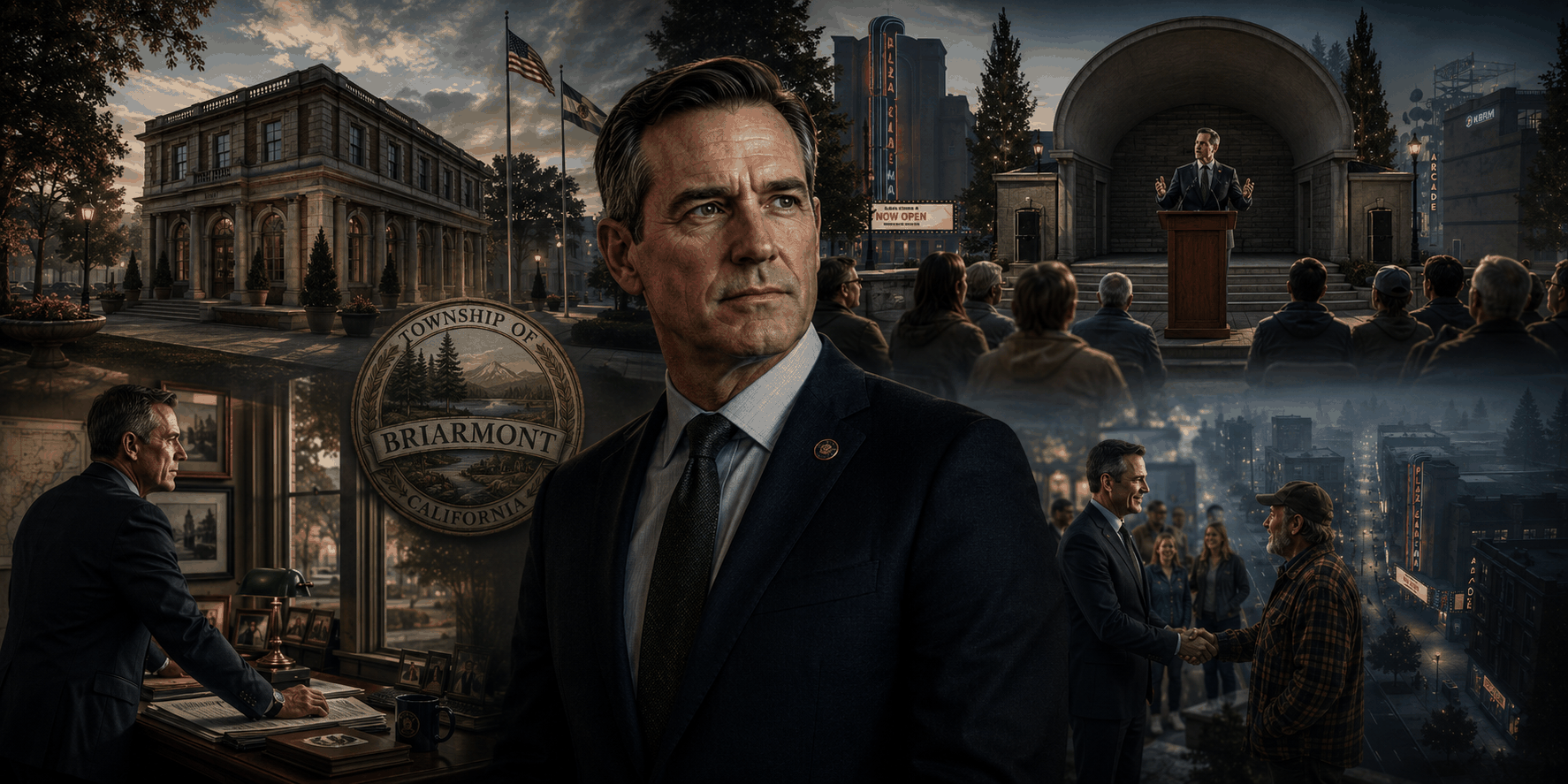
Clarence Ashton II is the current Mayor of Briarmont and one of the most visible modern representatives of the Ashton name. A descendant of the collateral Ashton branch rather than the line that inherited the Ashton Residence, Clarence occupies a complicated place in town history: close enough to benefit from the family’s old reputation, but distant enough to argue that he is not responsible for its oldest sins.
Politically, Clarence presents himself as an Independent and a pragmatic civic leader. He is generally understood as center-right in municipal terms: pro-business, careful with public spending, friendly to property owners, and supportive of controlled development when it can be framed as responsible growth. He speaks often of preservation, continuity, and protecting Briarmont’s character, though critics see him as overly polished and too comfortable deciding which parts of the town’s history should remain quiet.
Much of Clarence’s identity is shaped by the older Ashton wound. His branch of the family was never welcomed into the original Clarence Ashton’s household, and generations of exclusion hardened into ambition. As mayor, Clarence II embodies one of Briarmont’s oldest contradictions: the desire to honor history while controlling it.
Early Life
Clarence Ashton II was born in Briarmont in 1972, into the collateral Ashton branch descended from Caleb Josiah Ashton. His family was respectable, established, and locally known, but they carried a long memory of exclusion from the older Ashton household. The original Clarence Ashton had never welcomed Caleb’s line into the symbolic center of the family, and that slight became part of the atmosphere in which Clarence II was raised.
His childhood was comfortable, orderly, and closely managed. His father, Martin Avery Ashton, taught him that the Ashton name was not merely something inherited, but something to be restored, defended, and used well. Family stories rarely sounded openly bitter, but their meaning was clear enough: the main line had held the house, shaped the public memory, and decided who counted. Caleb’s descendants had survived outside that circle and built their own place in Briarmont without permission.
Clarence learned early how to behave in public. He was expected to be composed, articulate, well-dressed, and careful with his words. Teachers remembered him as intelligent and disciplined rather than especially warm. He was the sort of boy adults trusted with responsibility, partly because he seemed older than he was and partly because he had already learned how to make ambition look like maturity.
As a young man, Clarence left Briarmont for college and returned with a sharper understanding of local power. He studied government, law, or public administration, but his real education came from watching how boards, donors, property owners, civic committees, and old families shaped the life of a town. By the time he entered public life, he had learned the central lesson of his branch: history belonged to whoever could speak for it convincingly.
Education
Briarmont High School
Diploma, 1990
University of California, Davis
B.A. in Political Science, Minor in Urban and Regional Planning, 1994
University of California, Hastings College of the Law
Juris Doctor, 1997
Northern California Municipal Leadership Program
Certificate in Local Governance and Public Administration, 2006
Career / Employment
Associate Attorney, Whitcomb & Hale LLP
1997–2002
Worked in municipal law, land-use disputes, zoning appeals, estate matters, and small business contracts after completing law school.
Land Use and Municipal Counsel, Private Practice
2002–2010
Built a local legal practice focused on property owners, development applications, historic preservation disputes, civic boards, and regulatory negotiation.
Member, Briarmont Planning Commission
2006–2010
Served on the town’s planning commission, where he developed a reputation for controlled growth, procedural discipline, and careful attention to property and preservation issues.
Briarmont Town Council Member
2010–2018
Elected to town council on a platform of fiscal restraint, downtown revitalization, infrastructure repair, and preservation of Briarmont’s historic character.
Mayor of Briarmont
2018–Present
Elected mayor as an Independent. His administration has focused on responsible development, tourism management, public-private partnerships, historic preservation, and maintaining Briarmont’s civic identity without allowing the town to become economically stagnant.
Personality
Clarence Ashton II is composed, articulate, and difficult to catch off guard. He has the practiced calm of someone who learned early that authority is often maintained through tone, timing, and restraint rather than open force. In public, he is courteous and measured, rarely raising his voice and rarely saying more than he intends.
He is pragmatic more than openly ideological. Clarence prefers procedures, committees, private conversations, and carefully framed compromises. Supporters see him as disciplined, intelligent, and realistic about what Briarmont needs to survive. Critics see him as calculating, image-conscious, and too skilled at turning uncomfortable questions into broader discussions about balance, continuity, or civic responsibility.
Beneath the polish, Clarence carries a deep family pride. He is not sentimental about the Ashton name, but he is protective of it. His branch’s long exclusion from the original Ashton household left him with a quiet determination to prove that legitimacy does not belong only to the line that held the house. He can be warm when it suits him and sincere when he chooses to be, but he is always aware of the room, the audience, and the story being told.
Legacy
Clarence Ashton II’s legacy remains closely tied to the modern civic identity of Briarmont. As mayor, he has positioned himself as a defender of the town’s character while also supporting controlled growth, tourism, business investment, and public-private development. Supporters credit him with keeping Briarmont economically active without allowing it to lose its historic image.
His critics argue that Clarence is less interested in preserving history than in managing it. His administration has often favored careful language, polished public messaging, and selective remembrance, especially where the Ashton name, Hartwell Timber, and Oakridge’s origins are concerned. To them, Clarence represents an old Briarmont habit: turning uncomfortable history into something respectable enough to display.
Privately, Clarence is married and has two adult children, a family life that supports his public image as stable, respectable, and deeply rooted in town continuity. Whether he is remembered as a pragmatic steward or another Ashton skilled at controlling the story will likely depend on what Briarmont eventually chooses to uncover.
Credits
Written by: Charles Fairweather