
HCSD — Standard Operating Procedures
Hartwell County Sheriff's Department Standard Operating Procedure Policy Manual. Public reference.
401 - Incident Command System
401.1 USE OF INCIDENT COMMAND SYSTEM (ICS)
401.1 PURPOSE AND SCOPE
This policy provides all members with guidelines for use of the Incident Command System.
The Incident Command System (ICS) is a standardized but flexible, on-scene, all-hazards, integrated incident management concept that has been widely adopted and proven effective. The ICS includes a scalable organizational framework within which representatives from different departments and agencies can work together effectively, even if they do not routinely work together, to respond to disasters, emergencies, and planned and unplanned incidents of varying types, size, and complexity. The use of ICS is particularly important in Hartwell County, where many small entities, agencies, and jurisdictions must cooperate to be successful.
The ICS is a critical component in California's Standardized Emergency Management System (SEMS) and in the National Incident Management System (NIMS). The adoption and use of ICS are required to be in compliance with SEMS and NIMS regulations. Use of ICS is often required for government reimbursements of emergency response expenses, and/or for funding of certain specialized grants (Government Code § 8607(e)1).
401.2 POLICY
It is the policy of the Hartwell County Sheriff’s Department to utilize ICS to coordinate multiple jurisdiction or multiple-agency emergency and disaster operations (Government Code § 8607(d)).
Members of the HCSD may use ICS concepts and procedures even when the incident involves HCSD as the only jurisdiction and response agency. Members are encouraged to use ICS in small emergency incidents, planned events, and trainings to develop and maintain the skills and knowledge needed to effectively organize and respond to large and/or complex emergencies and disasters.
When HCSD members are assigned to assist another jurisdiction that is using ICS to manage an incident, emergency, or disaster, applicable provisions of this policy should be followed.
401.2.1 AUTHORIZED RESOURCES FOR ICS GUIDANCE
Members should use currently applicable federal (FEMA, NIMS) and state (Cal OES, Firescope, SEMS) trainings, manuals, and reference materials as the preferred resources for the implementation of ICS. Consideration may also be given to local agencies' protocols and procedures, but any significant deviation from current state and federal ICS guidance should be carefully evaluated and approved by an appropriate authority.
401.2.2 CRITERIA FOR INITIATING USE OF ICS IN UNPLANNED INCIDENTS
Deputies should use ICS in response to unplanned emergencies and disasters involving multiple jurisdictions and/or multiple response agencies, whenever the situation reasonably appears to be serious, complex, and involves one or more of the following conditions:
- Multiple agencies/jurisdictions involved.
- A natural disaster with serious and/or spreading dangerous conditions (e.g., earthquake, flood, landslide, pandemic, tsunami, volcanic event, wildland fire).
- An accidental emergency or disaster of a serious nature (e.g., airplane or bus crash, building collapse, dam failure, hazardous materials incident, large oil spill).
- An unplanned incident threatening the life safety of the community, and/or has high-profile interest to the public (e.g., barricaded subject, bomb threat, celebrity/dignitary in peril; civil unrest/riot, hostage situation, manhunt for dangerous suspect, missing person in immediate peril, officer-involved shooting, search and rescue operations).
Note: During initial response to a criminal multi-casualty incident (CMCI) in progress (e.g., active shooter, bombing, edged weapon attack, vehicle ramming), the ICS should be implemented as soon as reasonable and practicable. The first deputies on-scene may choose to take immediate action, while requesting additional assistance. Refer Rapid Response and Deployment Policy.
401.3 FIELD LEVEL USE OF ICS AT AN INCIDENT
401.3.1 INCIDENT COMMANDER REQUIRED
An Incident Commander (IC) must be present at the incident, and their identity clearly communicated to all involved or affected personnel. The IC is the only position that is always staffed in ICS applications.
401.3.2 INCIDENT COMMANDER RESPONSIBILITY
The member serving as IC has overall authority and responsibility for incident operations. The IC should identify the priorities, establish incident objectives, determine strategies, order resources, develop an ICS structure based on the incident and objectives, and manage the response.
401.3.3 DESIGNATION OF IC AND OTHER ICS LEADERS
- Leadership designation in an ICS organization should not be solely based on seniority. The IC and other leaders should be selected on who has the most appropriate combination of:
- Training, knowledge, experience, and expertise needed for the incident;
- ICS knowledge, management skills, and leadership abilities;
- Jurisdiction (legal, geographical) and discipline (e.g., Law, Fire, Public Works); and
- Supervisory authority (rank).
- When a hazardous substance incident (e.g., HazMat spill) occurs:
- On a county public roadway, a deputy may temporarily serve as IC before transferring IC responsibility to an arriving officer of the California Highway Patrol.
- On a city-owned roadway of a contract city served by HCSD, a deputy should serve as IC. However, as per Vehicle Code § 2454, the IC manages and coordinates the overall response, not dictating how specialized functions are to be performed.
- On any other property, the IC may be from a response agency (e.g., fire department, environmental services), the property's owner/manager, or the transporting entity, as appropriate for the situation. In the absence of any other resource, a deputy may temporarily serve as IC, but should immediately request assistance and transfer IC responsibility as soon as practicable.
401.3.4 DESIGNATION OF INCIDENT COMMAND POST AND OTHER FACILITIES
Members should support the prompt establishment of one Incident Command Post (ICP). Other facilities are optional, dependent on the circumstances and the wishes of the IC.
- The ICP should be near the incident (generally not at the HCSD Main Station or HCSD Emergency Operations Center). The IC should remain at the ICP until relieved.
- The ICP should be established in a "Cold Zone" incident support location, meaning that no significant danger or threat is reasonably perceived or anticipated there. If a danger or threat to the ICP becomes apparent, the ICP should be moved to a safer location, and the IC should move with it.
- The ICP's location should be promptly communicated to involved/affected personnel.
- Additional ICS facilities should be consistent with state/federal guidance and local protocols. These may include but are not limited to: Staging Area; Tactical Operations Center/Tactical Command Post; Negotiations Operations Center; Media Area; Patient Triage/Treatment/Transportation Area; Forward Operating Branch; Casualty Collection Point; Evacuee Collection Area; Incident Base; Local Assistance Center.
401.3.5 USE OF ICS TERMINOLOGY
Members involved with or assigned to an ICS organization should use ICS terms whenever practicable for organizational functions, position titles, incident facilities, and resources. Law enforcement "Ten-Codes" should be avoided, and plain speech used instead.
401.3.6 MAINTAINING UNITY OF COMMAND AND CHAIN OF COMMAND
Everyone assigned to an ICS organization (except the IC) should have only one ICS supervisor to whom they report. Members who are assigned more than one supervisor in the ICS, or who do not know to whom they report, should promptly attempt to resolve the issue. Members working in an ICS organization should follow the ICS chain of command during their assignment.
401.3.7 MANAGING SPAN OF CONTROL, EVERY TEAM WITH A LEADER
Everyone assigned to an ICS organization should be organized within a clear leader-subordinate structure. The span of control for each leader should be three to seven subordinates (depending on conditions, duties, abilities, safety, etc.). An individual leader is often most effective with approximately five subordinate workers (1:5). Members encountering a problem of span of control or a team without a leader should seek to resolve the issue.
401.3.8 USE OF MODULAR ORGANIZATION
Members should support modular development of an ICS organization based on the nature, size, complexity, hazards, and anticipated duration of an incident. Although ICS has a standardized framework, only the elements required to meet response objectives should be activated (staffed). The functions of any non-activated element should be the responsibility of the next highest staffed element in the organization.
401.3.9 FUNCTIONAL AREAS AND SECTION CHIEFS
A deputy serving as IC should activate (assign staff to) only those functional areas currently needed for effective management of the incident while maintaining reasonable spans of control. When a functional area grows in size and/or importance, it should be identified as a "Section", and a leader ("Section Chief") should be assigned to manage that functional area as soon as reasonably practicable. Until a Section Chief is assigned, the IC should manage that functional area. During the first minutes of an emergency, Teams, Task Forces, and Units may be activated, deployed, and supervised directly by the IC prior to appointment of anyone as a Section Chief. Functional areas that may be activated include:
- Operations ("Hands-on" work or tactical activities to achieve response objectives) (b) Planning/Intelligence (Prepares plan; collects and analyzes information)
- Logistics (Gets resources and support to the response effort and the responders)
- Finance/Administration (Monitors personnel time, costs and purchasing; contracts) Note: NIMS provides an option to create an "Intelligence/Investigations Section" for the functions of gathering, documentation, and analysis of sensitive and detailed information in complicated incidents such as acts of terrorism. In all but the most complex field responses, the resources for these activities should be normally placed within the Planning or Operations Sections.
401.3.10 INCIDENT ACTION PLANNING
When ICS is used for any incident, planned or unplanned, the IC must ensure an Incident Action Plan (IAP) is developed and effectively communicated to response personnel in a timely manner.
- The first IAP(s) may be verbal, including but not limited to a "Leader's Intent" statement communicated via radio in the first moments after arrival.
- During a lengthy response, subsequent IAPs may be written (ICS forms, consistent with NIMS/FEMA models, should be used). Members of the Sheriff’s Department of Emergency Services (HCSD OES) may be available to assist in the development of forms, IAPs, and/or provide guidance related to ICS organizational structures.
- The IC and assisting personnel developing the IAP should consider the following:
- Priorities (e.g., life safety; stabilize scene, protect property, environment, crime scene, and evidence; ensure viability of prosecution; restore normalcy);
- Objectives (specific, measurable, attainable, reasonable goals to pursue the Priorities, with timeframes);
- Strategies (the actions and resources to achieve the Objectives); and
- Tactics/Tasks/Activities (the language defining how specific actions will be performed and measured, specifying who/what/where/when).
To be effective, the IAP should:
- Cover a specified timeframe or "operational period"
- Specify the operational period objectives or "what must be accomplished"
- State the activities to be completed or "how it will be done"
- Assign roles/tasks or "who is responsible"
- Identify needed resources
- Specify communication protocols
- Identify safety constraints and procedures for responder safety
401.3.11 MANAGING COMMUNICATIONS
The IC should ensure that a communications plan is developed and shared with response personnel, including radio channel assignments. Members should follow the plan.
401.3.12 SHIFTING FROM DISPATCH CONTROL TO IC CONTROL
As the IC and on-site supporting personnel gain situational awareness and resource control at the ICP, the role of HCSD Dispatch changes. Dispatchers should allow the IC to lead the control/ coordination of deployed resources from the ICP. Dispatchers may continue supporting the effort, such as handling resource requests and forwarding tips and information. The Dispatch Center and ICP should continue to place regular phone calls to one another to stay updated.
401.3.13 SUPPORTING RESPONDER SAFETY
The IC should ensure that response plans and activities support a reasonable level of personal safety. The IC may assign the role of "Safety Officer" to a capable individual who monitors incident operations and advises the IC on safety matters. The Safety Officer should have the immediate authority to stop and prevent unsafe acts by responders. The IC and/or the Safety Officer should ensure that safety messages, briefings, and plans are communicated to involved personnel.
Members should follow safety guidance.
401.3.14 MAINTAINING ACCOUNTABILITY, OPERATING WITHIN ICS
Members assigned to an ICS organization should support and utilize procedures to provide the IC with an accurate picture of resources and their status. Members should take personal responsibility for their actions while operating within the ICS structure, including but not limited to:
- Report to the ICP, Staging Area, or other specified destination upon arrival.
- Follow check-in and assignment procedures established for the incident.
- Stay with their assigned leader, team, and objective, and avoid "free-lancing".
- Complete and submit activity logs (ICS-214) and other required documentation.
- Follow check-out and demobilization procedures established for the incident.
401.3.15 EXPANDING INCIDENTS AND MANAGEMENT ROLE OF IC
As an incident becomes larger/more complex, the member serving in the role of IC should strive to manage the ICS organization, not the operational details. The IC may consider:
- Adding Command Staff at the ICP, such as Scribe/Radio Monitor; Liaison Officer, Public Information Officer (PIO), Safety Officer, Deputy IC, etc.
- Activating a Staging Area staffed with a Staging Manager to receive and hold resources in a "stand-by" state until assigned, separate from the ICP.
- Adding a Logistics Section Chief to manage resource requests from the ICP, minimizing duplicate ordering.
- Delegating certain or specific authority by staffing an organizational level within the ICS structure with sole responsibility for tactical direction and control of selected resources. See also the Critical Response Unit and Mobile Field Force policies.
401.3.16 TRANSFERRING COMMAND AND BRIEFING OF NEW IC
Members should support effective transfer of command when a new IC arrives in person at the ICP. The transfer of command should be carried out face-to-face, with the outgoing IC providing to the new IC (prior to the transfer of authority) a briefing that captures essential information for continuing safe and effective operations. The date and time of transfer should be documented, and the identity of the new IC communicated in a timely way to all involved or affected personnel.
401.4 ARRIVING DEPUTY RESPONSIBILITIES AT AN UNPLANNED INCIDENT
When an unplanned incident reasonably appears to meet the criteria for implementing ICS as described in § 401.2.2, arriving deputies, supervisors, and managers should consider the ICS field level procedures described in § 401.3, and the following guidelines:
401.4.1 ASSUMPTION OF IC ROLE BY ON-SCENE DEPUTY
The role of IC should be assumed by a deputy that is on-scene, or about to arrive on-scene. In situations when one deputy's arrival will precede another's arrival by several minutes or more, the first deputy on-scene should assume the role of IC and may transfer command later.
401.4.2 INITIAL RADIO TRANSMISSIONS BY THE FIRST IC
When first establishing ICS (unless life safety or operational success would be jeopardized by radio transmissions), the on-scene deputy assuming the role of IC should promptly broadcast appropriate ICS statements in plain speech on the assigned HCSD frequency for the incident:
- The IC should identify themselves on the radio and their current location.
- The IC should name the incident over the radio by using an easy-to-understand plain-speech reference (e.g., "Hartwell Avenue Incident", "Manhunt", "Peace Rally", etc.).
- The IC should begin using the incident name, not their day-to-day radio call sign, as the IC's radio identifier (e.g., "Braughler IC", "Manhunt IC", "Rally IC"). Dispatch should thereafter use the incident name as radio identifier for whoever is serving as the IC.
- The IC should identify where their Incident Command Post (ICP) will be located (e.g., "My Command Post is at my vehicle at Oakridge College.").
- The IC should radio an initial "size-up" of the nature and magnitude of the incident shortly after arrival, verbalizing their observations and/or information gleaned from reliable sources and deputies on-scene ("This is Braughler IC. The suspect is in the cottage at 1000 Hartwell Avenue Road, armed with a silver revolver, fired one shot in the air, no injuries to anyone at this point. He has been yelling out the window and waving the revolver…We are starting an inner perimeter; Patrol Deputies are starting to block off traffic from entering Hartwell Avenue at Oakridge Drive.").
- The IC should request response of additional resources that may be needed (e.g., " Braughler IC, requesting additional deputies. Have the Duty Officer call me, we may need SWAT and Crisis Response. Also request K-9, and EMS and Briarmont Fire to respond and stand by.")
- The IC should specify the safest route of approach and destination for responding agencies (e.g., "Advise resources to approach via Oakridge Drive from the Hartwell Avenue Coastal Standard Gas Station – that will be the Staging Area.")
- The IC should specify the radio channel(s) to use for the incident (e.g., "Dispatch and all units on the Manhunt Incident, switch to CLEMARS/CALAW1; advise arriving agencies to switch to that channel. CHP, if available, can run traffic control on their channel.").
- The IC should broadcast their initial "Leader's Intent" for the initial response and the desired end-state (e.g., "Let's finish the inner perimeter to keep the suspect located and isolated, and get neighbors to shelter in place…Smith, start dialogue with him if you can do so safely…while we wait for more resources…give him time to surrender.").
401.4.3 INCIDENT COMMANDER ACTIONS
The deputy serving as IC should manage of the field response from the ICP as reasonable, practicable, and appropriate for the situation. The IC should consider the following actions:
- Confirm that HCSD response is, in fact, really needed (if no response is warranted, consider terminating the response). Broadcast what is happening or has happened.
- Confirm and broadcast the Location the response is most needed, and any "Hot Zone" area information where a threat or danger is perceived as direct and immediate.
- Broadcast an estimated number of persons injured and their location(s).
- Assess the need for additional resources and request them, providing a destination.
- Direct initial responders to Isolate the incident with inner and outer perimeters; add traffic control as appropriate and resources allow. Designate radio channels for these.
- If emergency alerts and messaging to the community may be appropriate, contact Dispatch and request notification HCSD Admin, and the Sheriff Department’s Office Manager. Seek approval before initiating alerts and messaging.
- Ensure that arriving resources are briefed and directed upon arrival. Make clear communications of Leader's Intent, assignment, who is working for whom, and safety.
- Direct on-site responders to Evacuate innocent persons believed to be in peril within the incident, or to shelter in place, as reasonable, safe, and practicable.
- Seek to keep involved persons and witnesses at the scene, or at least identify them.
- Assign a Situation Status deputy (may be part of the ICS Planning Section) to gather information with the understanding that they will be writing a report later about what happened and what is happening now. In a criminal incident, this deputy gathers leads and identifies crimes. Use them as a resource to keep informed and to update the IAP.
- Assign a Scribe/Radio Monitor to work alongside the IC, recording important events and their times, listening to the radio and, (as authorized) fielding inquiries on the radio.
- Plan for contingencies ("What ifs?") such as a strong aftershock, structure fire, trapped victim, suspect exiting, hostage fleeing, shots fired, officer down, etc. If appropriate, assign personnel with a leader as a "React Team" ready for quick action.
- If the HCSD Crisis Response Unit (CRU: comprised of SWAT) Commander arrives, the IC must clearly establish the scope of authority to act assigned to the CRU Commander and CRU team (refer Crisis Response Unit policy).
- Assign a Resource Status person to track resources deployed, staged, released.
- Use a map and/or floor plan and an organizational chart at the Incident Command Post to track deployment and facility locations, geography, and the ICS organization.
- Wear an IC vest, when one becomes available, when serving as the IC at the ICP.
- Delegate! (The IC must refrain from trying to do everything themselves.).
- Notify appropriate department, county, and allied agency officials. Consider requesting the activation of the HCSD EOC to assist with coordination and resources.
- Request the Sheriff's Department’s Office Manager to assist with the media.
401.5 UNIFIED COMMAND
When multiple agencies have responsibility (legal, geographical, or functional) and arrive at an incident, HCSD members should consider an ICS organization that utilizes a Unified Command (UC) approach instead of a single IC. The UC is comprised of two or more on-site IC's representing their different agencies. The UC establishes a common IAP with jointly approved objectives and strategies. This is accomplished without losing or abdicating agency authority, responsibility, or accountability. The following guidelines should be considered:
- A pre-planned incident may be organized using Unified Command concepts.
- An unplanned incident may begin with a single IC, and then transition to a UC.
- Supervisory approval is not required for Unified Command. It may be initiated as soon as the first deputy arrives on-scene, meets with, and reaches agreement with the on-scene leader of another agency that a UC should be formed.
- A deputy entering into a UC should follow the applicable guidelines described earlier in this policy, except that the deputy should make clear verbal and radio statements communicating to Dispatch and all involved/affected personnel that "Unified Command" has been established, including which agencies are participating in UC.
- The UC should operate from one Unified Command Post (UCP).
- The ICs participating in UC should be co-located at the UCP, in close verbal and physical proximity (i.e., standing shoulder-to-shoulder).
- Depending on the nature and evolution of the incident, one agency represented in the Unified Command may have a primary role among the other agency leaders (e.g., in a CMCI, Law may take the primary role until the threat ends, and then Briarmont Fire/EMS may assume the primary role until all salvageable patients are transported, then Law may reassume the primary role for Coroner and crime scene operations).
- The UC may be terminated when necessary or when one agency's involvement is no longer needed, and the ICS organization may be changed to a single IC model.
401.6 MULTIPLE INCIDENTS AND AREA COMMAND
There may be multiple simultaneous incidents, each of which requires an ICS approach to organize and manage. Lieutenants and higher-ranking members have important management roles in ensuring appropriate application of the guidance provided in this section.
401.6.1 SEPARATE INCIDENT COMMMANDS
Two or more simultaneous incidents different in nature and/or isolated from one another may be managed by separate ICs at different ICPs, each with their own different resources. For example, an officer-involved shooting at Breakwater Brew could be led by an HCSD corporal patrol deputy in Ashenfall as "Breakwater IC", while the response to a protest near Gorse Row is led by a HCSD sergeant patrol deputy in Thornmere as "White Pantry IC".
401.6.2 SEPARATE BRANCHES WITH ONE IC
Two or three closely located, similar but separate incidents may be managed by one IC. For example, response to simultaneous bomb devices at different ends of the College of the Redwoods campus could be led by an HCSD Lieutenant, in Unified Command with a fire department Battalion Chief, at a single UCP, as "Redwoods UC" ("Redwoods IC" would also be acceptable). Separate Branch Directors could manage the separate bomb scenes.
401.6.3 AREA COMMAND
When multiple but separate incidents of the same general kind are anticipated or break out in the same general area (e.g., scattered sites of rioting, separate flooding incidents along several rivers, simultaneous evacuations of several communities), the ICs (or UCs) managing the different incidents will compete for many of the same resources. An Area Command approach should be immediately considered. An experienced supervisor or manager should assume the role of Area Commander and announce their assumption of Area Command on the radio. The Area Commander (and supporting staff) responsibilities may include:
- Setting overall priorities and strategic objectives for the affected geographic area.
- Ensuring an IC is assigned appropriately to each incident and supported.
- Providing the ICs with expectations, intentions, and constraints.
- Allowing the ICs reasonable flexibility in implementing their individual IAPs.
- Prioritizing effective allocation/re-allocation of resources between incidents.
- Maintaining contact with officials, cooperating agencies, and other groups.
- Centralizing management of media and public information.
- Coordinating demobilization or reassignment of resources between incidents.
401.6.4 UNIFIED AREA COMMAND
Simultaneous incident field responses under an Area Command will often be multi-agency and/or multijurisdictional and may have Unified Command structures at their ICPs. If the field responses at the incidents involve Unified Command, the Area Command should be a Unified Area Command. This will require full jurisdictional representation at the Unified Area Command Post, and that all parties agree on the overall priorities, strategy, and agency responsibilities.
401.6.5 AREA COMMAND/UNIFIED AREA COMMAND GUIDANCE
Members seeking additional guidance for the use of Area Command and/or Unified Area Command should refer to current resources from California Firescope, SEMS, or NIMS. Staff will need to be identified and appointed to support either type of command organization; the positions to fill will depend on the nature of the incident and the needs of the response.
401.7 COMMAND POST CONSIDERATIONS
Some of the criteria that should be considered when selecting any Incident Command Post, Area (or Unified) Command Post location/facility include:
- The anticipated duration of the response
- The number of personnel anticipated to use the ICP
- Communication functionality to/from the site
- Proximity to the incident(s), and their location and total number
- Close to but separate from Staging Area and most other ICS facilities
- Separation from most walking wounded and fleeing persons
- Security from unauthorized persons, media, and others drawn to the scene
- Protection from the elements
- Adequate parking
- Water and bathroom facilities
- Capability for continuous operation and backup power
- Utilities, heating/cooling, lighting, and functionality
- Workspaces and furnishings
- Space for personnel and meetings
- Availability of nearby food/lodging if needed
401.8 MAJOR DISASTERS AND MULTIPLE AREA COMMANDS
During the initial response to a major disaster in the county (e.g., severe storm event, destructive earthquake) members should consider the following guidelines:
- Using information from field units, allied entities, the HCSD EOC, and other sources, a preliminary assessment of the type, scale, and general geographic area(s) of the existing and potential damage impacts should be developed.
- For each impacted geographic area, an Area Command (AC), or a Unified Area Command (UAC) may be formed in proximity to the damage, with a nearby Staging Area for resources assigned to that impact area. A law station, fire station, or meeting space could serve as a command post. Agency representatives (e.g., Law, Fire, Public Works, Caltrans) may consider co-locating at the command post to form a UAC.
- Each AC or UAC should be given a radio identifier in the same way that an individual incident has an individual name (e.g., "Ashenfall AC", "Thornmere UAC").
- On-scene operations for individual sites should be managed by on-scene ICs or UCs. The ICs/UCs may be coordinated by the AC/UAC.
- The AC or UAC should attend to the Area Command responsibilities described in § 401.6.3, above.
- The AC or UAC should lead the allocation of resources arriving within the impacted area.
- The involved agencies should ensure their dispatch centers are aware of the establishment of the AC or UAC.
- Dispatch centers and AC's/UACs should establish direct lines of communication (avoiding radio if practicable since many channels will be in use), coordinating the allocation, tracking, and accountability of on-duty resources with the AC or UAC.
- The Sheriff, as the County of Hartwell Operational Area (OA) Director of Emergency Services, may serve as "OA Command", providing leadership, direction, and coordination between the ACs or UACs. The Sheriff should be supported by members of this office, including HCSD OES.
401.9 HARTWELL COUNTY OES EMERGENCY OPERATIONS CENTER (EOC)
The Hartwell EOC is a physical (or virtual, if appropriate) location from which representatives of the HCSD, the County of Hartwell, and other jurisdictions and organizations coordinate information and resources to support the management of a serious incident, hazard, emergency, or disaster affecting Hartwell County. The Hartwell EOC may be activated as a local EOC or as a countywide EOC for the entire Hartwell Operational Area. The Hartwell EOC is normally located in the Hartwell County Courthouse, but an alternate physical location or virtual approach may be developed as an EOC to meet demands of the situation.
401.9.1 EOC MANAGEMENT AND FUNCTION
The Hartwell EOC is operated by the Sheriff's OES Manager and staff, using organizational concepts and structure established through NIMS, SEMS, and ICS. The primary functions of staff in the Hartwell EOC include:
- Collecting, analyzing, and sharing information internally and externally.
- Supporting resource needs and requests, such as interfacing with regional, state, and national organizations to allocation and tracking.
- Providing a range of planning services; determining current and future response needs.
- In some situations, providing coordination and policy direction.
401.9.2 EOC ACTIVATION
The HCSD EOC may be activated (staffed) at any time upon order of the Sheriff, Undersheriff, Duty Officer, or Emergency Services Manager. The EOC's activation levels are comparable with those of the California Coastal Region EOC (REOC) and State Operations Center (SOC).
- Level Three (lowest): This is a minimum activation. The EOC is staffed by two or more people to monitor a new incident or situation, collect and analyze information, and assist in the preparation and release of information to key officials and messaging to the public. Level Three could also be appropriate during first hours or the final days of an incident response. Typical hours of EOC activation at Level Three do not run 24/7.
- Level Two (partial activation): Typically established as an increase from Level Three or a decrease from Level One. This activation level is used for emergencies or planned events that would require more than a minimum staff but would not call for a full activation of all organization elements. The EOC Director, in conjunction with the General Staff, will determine the required level of continued activation, and demobilize functions or add additional staff to functions as necessary based upon event considerations. Representatives to the EOC from other agencies or jurisdictions may be needed under Level Two. Typical hours of EOC activation at Level Two extend beyond weekday business hours, but do not run 24/7 seven days a week.
- Level One (full activation): The EOC is staffed by many persons filling all Section Coordinator positions as well as other key roles. The EOC staff may include significant numbers of personnel from other Hartwell County departments and allied entities. A Level One activation may be appropriate to coordinate resource requests for a major disaster such as a severe earthquake. Level One EOC hours of operation will extend well beyond weekday business hours and may be activated 24/7, seven days a week.
401.10 REQUIRED COMPONENTS OF SEMS AND NIMS
In addition to using ICS, members of this office should utilize other components of SEMS and NIMS whenever reasonable and practicable to coordinate multiple jurisdiction or multiple agency operations (Government Code § 8607(a)). These components include:
- Multiagency Coordination Systems (MACS), including but not limited to facilities, equipment, multiagency coordination entities, procedures, and communications to coordinate activities above the field level and to prioritize the incident demands for critical or competing resources. Examples of MACS include EOCs and Area Command.
- Operational Area and Regional Area Approach for the coordination of mutual aid and other emergency operations (Government Code § 8559).
- An "operational area" is a county, including all political subdivisions within it.
- A "mutual aid region" is an area of California consisting of two or more county operational areas.
- The Statewide Mutual Aid Agreement, and related mutual aid systems and agreements such as those used in law enforcement, fire service, and coroner operations (Government Code § 8561). Members of this office should refer to the following sources of guidance:
- Current agreements between agencies and entities in Hartwell County, including any between the Law Enforcement Chiefs Association of Hartwell (LECAH).
- Current Cal OES documents such as: Blue Book Law Enforcement Mutual Aid Plan, Law Enforcement Mutual Aid Quick Reference Guide, Search & Rescue Mutual Aid Annex and documents, Coroners & Mass Fatality documents, the California Disaster and Civil Defense Master Mutual Aid Agreement, and the Emergency Management Mutual Aid (EMMA) Plan.
- The Sheriff’s Department of Emergency Services (HCSD OES).
401.11 ASSESSMENT AND REVIEW
Members should support and participate in assessments of incident responses, including how the ICS was implemented. Assessment methods include but are not limited to:
- On-scene or nearby "hot wash" in-person meetings immediately after an incident
- Formal Debriefings and Post-Incident Analysis meetings
- After-Action Review/Report Meetings
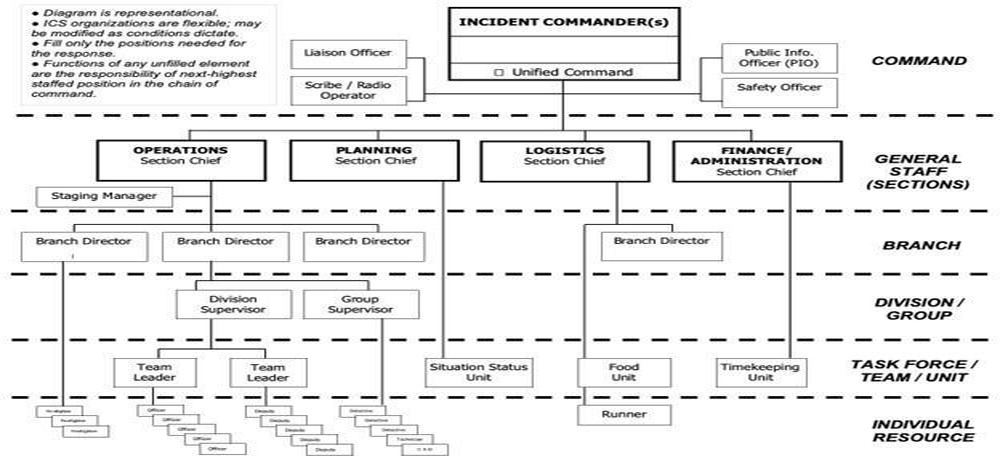
401.12 ICS STRUCTURE, TITLES, AND ORGANIZATIONAL CHART
Under NIMS and Firescope guidelines, the ICS in field response situations is organized by levels, with the individual supervisor of each level holding a specific title during their participation in the response (e.g., a person in charge of a Section is labeled "Chief"; a "Director" is the title of a person in charge of a Branch). Additional position titles are described later in this section.
401.12.1 LOCAL PRACTICES
The use of the NIMS/Firescope-endorsed ICS titles such as "Section Chief" is the common practice by Hartwell County fire and rescue agencies and therefore should be the practice of members of this office in most field response situations.
- Some entities may use the title "Officer-In-Charge" (OIC) to designate leaders at each level instead of using NIMS/Firescope terminology.
- In EOC organizations, position titles may vary slightly from field response ICS titles (e.g., an EOC may have a "Section Coordinator" rather than a "Section Chief").
401.12.2 LEVELS AND TITLES – FIELD RESPONSE ICS
Members of this office should use the following titles when activating (staffing) these positions.
- COMMAND (IC is required; adding a Deputy IC is optional.)
- Incident Commander
- COMMAND STAFF (Activate only those needed; adding Assistants to staffis optional.)
- Scribe / Radio Monitor
- Safety Officer
- Liaison Officer
- Public Information Officer (PIO)
- GENERAL STAFF (Activate only those needed; adding a Deputy Chief is optional.)
- Operations Chief
- Planning/Information Chief
- Logistics Chief
- Finance/Administration Chief
- IMPORTANT ICS ELEMENTS
- Branch "Director": When activated, a Branch has either functional or geographic responsibility for major parts of the Operations or Logistics functions. The Branch level is an optional level of supervision beneath a Section Chief, overseeing designated Divisions, Groups, Task Forces, Teams, or Units.
- Division "Supervisor": As an optional level within the Operations Section, a Division divides an incident into geographical areas of operational responsibility. One example would be to divide responders working on opposite sides of a river into the "North Division" and the "South Division". Each Division Supervisor oversees their designated Task Forces, Teams, or Units.
- Group "Supervisor": As an optional level within the Operations Section, a Group divides an incident into functional areas of operational responsibility. One example might be to divide responders into a Search Group and an Investigative Group. Each Group Supervisor oversees their designated Task Forces, Teams, or Units.
- Team, Task Force, or Unit "Leader": These refer to organizational elements with functional responsibility for a type of activity or assignment. Teams are typically created with three to seven of the same type of resources while Task Forces are comprised of different types of resources. Examples include: "Inner Perimeter Team" (all armed law officers), and "Rescue Task Force" (armed law officers in a team with firefighter/paramedics). "Units" are most commonly used to designate certain functional responsibility in Logistics, Planning, or Finance Sections.
Biased-Based Policing