
 | |
| Rebecca Anne Calder | |
| Born | June 12th, 1960 |
|---|---|
| Honorific | Sheriff |
| Nickname | Bex |
| Gender | Female |
| Eyes | Hazel-green |
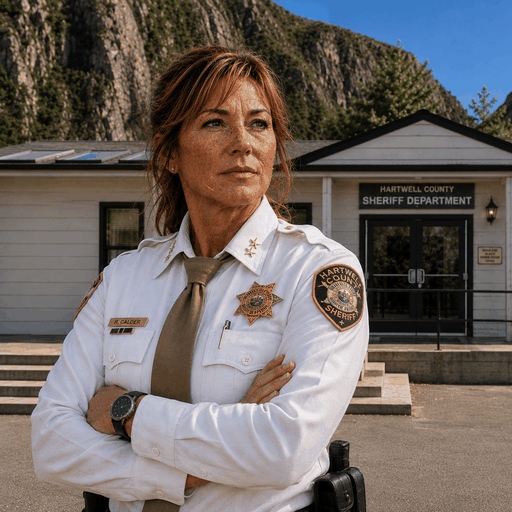
| Hair | Dark Auburn/Reddish Brown, with grey now worn in a practical ponytail or braid. Often kept at shoulder length |
| Height | 5'8" (173 cm) |
| Weight | 150 lbs (68kg) |
| Organization | Hartwell County Sheriff's Department |
| Past ranks | Sheriff |
| Affiliations | Briarmont Fire Department |
History
Rebecca Anne Calder was born on June 12, 1960, in Brackenmere, a coastal community part of Briarmont, and Hartwell County, California. The coastal community was known for surf breaks, fishing piers, and close family networks. She grew up around both the ocean and public service. Her father was a volunteer firefighter, and her mother was a schoolteacher, giving Calder an early understanding of community responsibility from two very different directions.
As a teenager, Calder was active, competitive, and restless. She became known as a strong surfer and spent much of her youth around Brackenmere’s beaches, piers, and firehouse culture. Her nickname, “Bex,” followed her from those years into adulthood and later into her law enforcement career.
Although many assumed she would remain close to Brackenmere, Calder came of age during a period when Hartwell County was undergoing significant changes. By the 1980s, the county was facing growing tension between Oakridge College, expanding suburban districts, coastal communities, and rural areas that still expected traditional local services.
Calder returned from college with a practical understanding of those pressures and entered public safety at a time when women were still pushing hard for space in the field. Her career would eventually make her one of the defining modern figures of the Hartwell County Sheriff’s Department.
Education
Rebecca Calder attended Oakridge College and graduated with the Class of 1981. She majored in Criminal Justice and minored in Fire Science.
That combination shaped the rest of her career. Calder was trained to think across two disciplines that were often treated separately: law enforcement and fire response. Her education gave her a foundation in criminal procedure, emergency management, investigation, fire behavior, and public safety coordination.
While still a student, Calder also spent time around local fire service work, first through part-time and volunteer duties connected to Brackenmere and Hartwell County fire response. This gave her early field exposure before she entered public safety full time.
This background later proved critical during the Phantom Flame arson cases, where Calder’s ability to understand both fire scenes and criminal evidence made her one of the department’s most valuable investigators.
Employment
Firefighting Career
Volunteer Firefighter
1980–1981
While completing her final years at Oakridge College, Calder served in a part-time and volunteer capacity with local fire services. This early work placed her close to emergency response before she formally entered law enforcement.
Her duties were limited compared to later career roles, but the experience mattered. She learned firehouse discipline, emergency coordination, equipment handling, scene safety, and the practical realities of working under pressure. It also strengthened her interest in Fire Science and gave her a direct connection to the public safety culture she would later help bridge with law enforcement.
This period became the first step in Calder’s long association with fire response, arson investigation, and inter-agency cooperation.
Firefighter and Deputy Sheriff
1985–1995
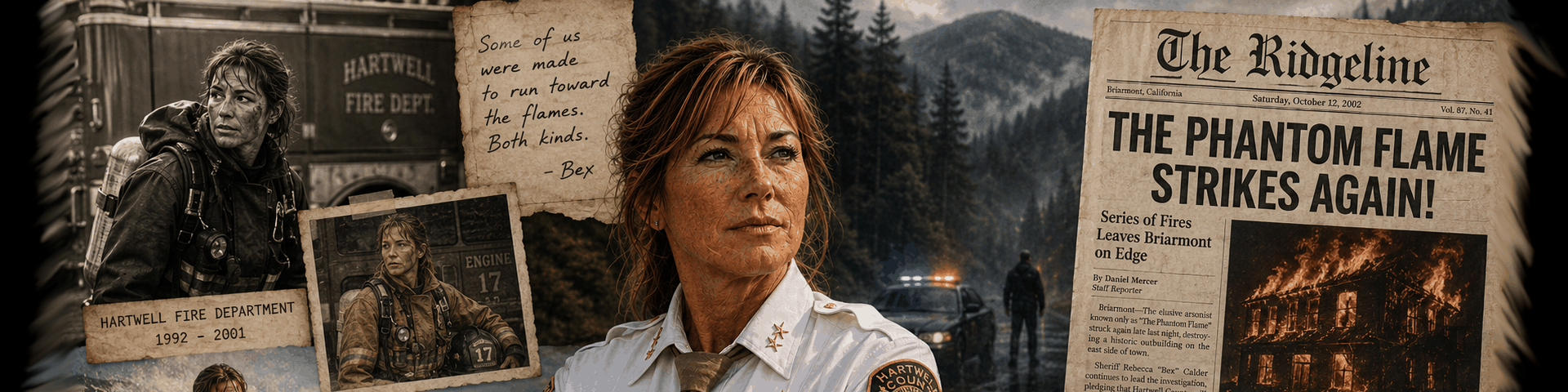
Calder began her public safety career as a firefighter while cross-training as a Deputy Sheriff. What began as an unusual dual role became increasingly important during the Phantom Flame arson cases, which affected Hartwell County from 1986 to 1992.
The Phantom Flame targeted abandoned buildings, college-adjacent properties, and coastal warehouses. Several fires were sophisticated, and some appeared to have been used as distractions for other crimes. Calder’s combined knowledge of fire science and law enforcement allowed her to read scenes from both perspectives.
Her work on several key cases made her a respected local figure and helped prove the value of closer cooperation between fire services and the Sheriff’s Department. This period directly contributed to the later formal embedding of fire and arson investigation functions within the HCSD.
Undersheriff
1995–1999
Calder was promoted to Undersheriff under the previous Sheriff and became one of the public faces of departmental modernization.
In this role, she pushed for stronger training standards, more professional expectations, and better support for women recruits and deputies seeking specialized roles. Her promotion also marked a visible challenge to the department’s older “old boys’ club” culture.
Supporters saw her as a necessary reformer. Critics viewed her as ambitious and disruptive. Both reactions helped define her rise.
Sheriff of Hartwell County
2000–2025
Rebecca Calder was elected Sheriff of Hartwell County in 2000 and served until her retirement at the end of 2025. She was re-elected four times and led the department for a full quarter-century.
Her administration focused on modernization, training, inter-agency cooperation, forensic improvement, public outreach, and the expansion of women in leadership and specialized assignments. She strengthened coordination between law enforcement, fire services, EMS, Oakridge College, and other public agencies.
One of her most important reforms was the creation of the College Response Bureau in 2004. The bureau was established after a serious campus incident showed the need for deputies trained specifically in Oakridge-related matters, including student safety, parties, mental health crises, Greek Row incidents, and town-and-gown conflicts.
Calder retired in December 2025 at the age of sixty-five. She left behind a more professional and better-respected department, though not one free of unresolved questions. The Phantom Flame case was never fully closed to public satisfaction, and some residents still believe the true culprit may never have been identified.
Personality
Rebecca “Bex” Calder’s approach to law enforcement was shaped by field experience, emergency response, and a strong belief in practical responsibility. She did not see public safety as a matter of appearances or rank alone. To her, authority had to be useful, disciplined, and prepared.
Calder believed that a good deputy should know how to read a scene before acting. That philosophy came partly from fire response, where rushing in without understanding conditions could make things worse. She carried that same thinking into law enforcement: observe, act decisively, and do not confuse noise with control.
She was tough, but not reckless. Calder valued evidence, training, inter-agency cooperation, and clear standards. She had little patience for sloppy work, ego-driven policing, or the assumption that tradition alone made something correct. This made her respected by many younger deputies and disliked by some older ones.
Her morality was rooted in service, but not sentimentality. She cared deeply about Hartwell County, but she was not soft about it. She believed the department had to modernize to remain worthy of public trust, even if that meant angering people inside the agency.
Calder was especially committed to opening paths for women in public safety. She did not treat her own rise as enough. She expected the department to become a place where women could serve, lead, specialize, and be taken seriously without having to be treated as exceptions.
In retirement, her philosophy is often summarized by those who served under her as simple but demanding: know the county, know the work, keep your head, and do not waste the public’s trust.
Legacy
Rebecca “Bex” Calder is remembered as one of the most important modern Sheriffs in Hartwell County history. Her tenure represents the department’s transition from an older rural law enforcement culture into a more professional, specialized, and publicly accountable agency.
Her legacy is especially visible in fire and arson investigation, women’s leadership, college response, training standards, and inter-agency cooperation.
Calder’s early dual role as firefighter and Deputy Sheriff became one of the defining parts of her public image. During the Phantom Flame years, she proved that fire investigation and criminal investigation could not always be separated cleanly. The department’s later fire and arson investigation capacity owes much to the precedent she helped establish.
She is also remembered as a mentor to women in HCSD. Calder did not simply rise through the department as an exception; she used her position to make the path wider for others. Her administration pushed women into leadership, field command, investigation, fire and arson work, and other specialized roles.
The College Response Bureau remains one of her most visible institutional reforms. Founded in 2004, it changed how the department handled Oakridge College incidents and helped formalize the relationship between HCSD, campus administration, Greek Row, students, and the wider town. The bureau also remains one of the more debated parts of her legacy, with critics arguing that college-connected cases sometimes received special attention.
Her administration also improved cooperation between law enforcement, fire services, EMS, and other county agencies. This became one of the practical foundations of the modern HCSD and reflected Calder’s belief that public safety work could not be divided into isolated silos.
Calder’s public image combines toughness, competence, and local familiarity. She is remembered as a surfer from Brackenmere, a firefighter’s daughter, a field officer, a reformer, and a Sheriff who could be both calm and intimidating. In department culture, stories about her often emphasize her ability to read a room, read a scene, or wait out a lie.
Her legacy is not without scars. The Phantom Flame case still follows her name, especially because the arsonist was believed dead after a major fire in 1992, but never fully resolved in the public mind. Her reforms also created enemies among those who preferred the older culture of the department.
Even so, Calder is widely regarded as the Sheriff who carried HCSD into the twenty-first century. She inherited a department still shaped by older habits and left behind one better trained, more specialized, and more prepared for the complex needs of modern Hartwell County.
Credits
Written by Charles Fairweather, Jack Braughler, and Evelyn Velt