
 | |
| Sheriff | |
| Type | Civic, Law |
|---|---|
| Affiliations | Hartwell County Sheriff's Department |
| Leaders | Hartwell County Sheriff's Department |
| First holder | Edward Plainview |
Responsibilities
The Sheriff’s responsibilities include both direct law enforcement authority and broad administrative leadership.
The office is responsible for preserving public peace, arresting violators, preventing and suppressing disorder, investigating public offenses, supporting the courts, serving court processes, overseeing prisoner handling, and maintaining proper custodial care for those held under county authority.
The Sheriff also supervises the department’s bureaus and divisions, including administration, patrol operations, civil services and court protection, major crimes, school resource and college response, crisis response, and other specialized or support functions as staffing and funding allow.
In modern practice, the Sheriff is expected to maintain a professional department grounded in training, accountability, constitutional rights, public trust, and community partnership. This includes setting policy, approving organizational structure, ensuring compliance with state and local law, overseeing major incidents, supporting emergency management, and maintaining the department’s relationship with the public.
The Sheriff may also personally perform sworn law enforcement duties when required, though the office primarily functions as the department’s executive command authority.
Duties
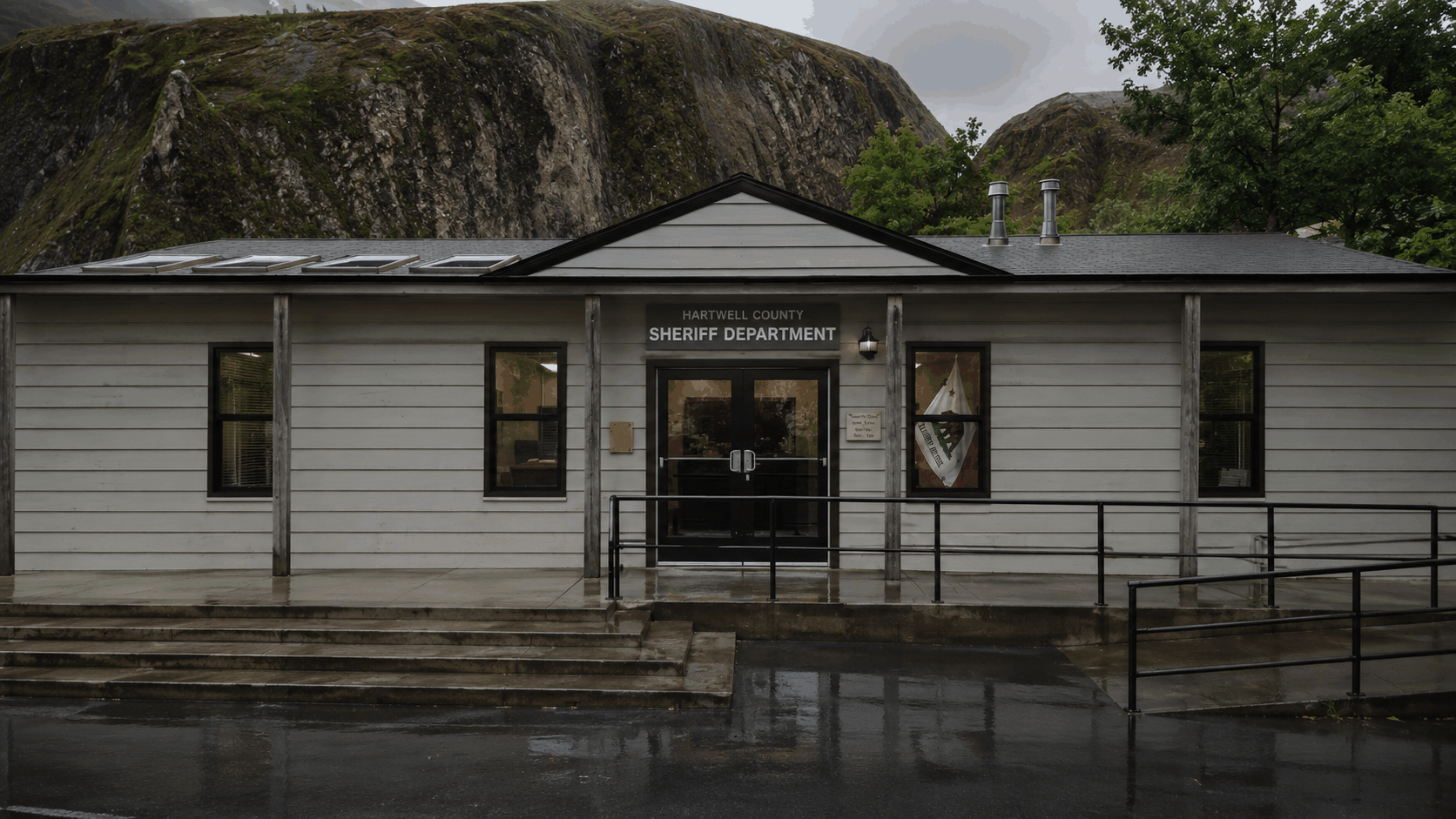
The Sheriff of Hartwell County is the chief executive officer of the Hartwell County Sheriff’s Department and the final authority over department policy, operations, discipline, command structure, and public service priorities.
The Sheriff is responsible for the preservation of peace throughout Hartwell County, Briarmont Township, and the surrounding districts. The office carries authority beyond ordinary patrol policing and includes law enforcement, court support, civil service, corrections, coroner-related duties, emergency response, and public administration functions.
As the county’s chief law enforcement officer, the Sheriff oversees the enforcement of applicable laws and ordinances within HCSD jurisdiction, directs sworn and non-sworn personnel, issues lawful orders, maintains department standards, and represents the agency in its relationship with county government, the Board of Supervisors, public agencies, civic institutions, and the residents of Hartwell County.
History
The Office of the Sheriff in Hartwell County was established during the county’s earliest period of formal government. Hartwell County was formed in 1858, and the Hartwell County Sheriff’s Department followed in 1859, at a time when Briarmont and its surrounding lands were still being shaped by timber extraction, settlement pressure, road building, and disputes over property and access.
From the beginning, the Sheriff’s office was tied to the practical realities of a young county built around Elias Hartwell’s influence. Hartwell’s timber operations brought money, labor, conflict, and rapid development into the region. The Sheriff’s Department emerged as one of the county’s first major public institutions, charged with enforcing law and order across a landscape where private industry, civic authority, and land ownership were often closely connected.
In its earliest decades, the office dealt with violent disputes over land, timber rights, road access, water use, labor conditions, and claims between residents, workers, businesses, and older local communities. Public records often described these matters in restrained legal language, but local memory preserved them as part of the rough Hartwell years, when the county was still deciding what kind of place it would become.
The first Sheriff, Edward Plainview, gave the office its earliest reputation for firmness and direct action. His administration reflected the needs and limits of frontier county law enforcement. Deputies were expected to know the roads, camps, mills, settlements, and disputes of the county. The work was physical, immediate, and often personal. The department did not yet resemble a modern law enforcement agency with formal bureaus and specialized divisions.
As Briarmont grew beyond its timber-camp origins, the Sheriff’s office changed with it. The decline of the first timber boom, the death of Elias Hartwell, and the later establishment of Oakridge on the former Hartwell estate all shifted the county’s center of gravity. The Sheriff’s Department became less a tool of frontier order and more a permanent county institution responsible for a growing civic community.
The arrival of formal county court services in the early twentieth century further expanded the Sheriff’s role. Court security, civil process, prisoner movement, warrants, and judicial support became increasingly important parts of the office. The later consolidation of court-related duties under the modern Sheriff strengthened the department’s role as both a law enforcement and court-support agency.
During the twentieth century, the office continued to adapt to new pressures. Prohibition, road expansion, college growth, rural crime, missing persons cases, and the increasing complexity of county government all shaped the department’s development. The Sheriff was no longer only a field lawman, but an administrator, public representative, and command authority.
The mid-century period brought some of the office’s most enduring stories, including the disappearance of Sheriff Harold “Hal” Humbolt during the 1959 Bellamy investigation. Humbolt’s loss became part of the department’s institutional memory and remains one of the most important unresolved events in HCSD history.
By the late twentieth and early twenty-first centuries, the Sheriff’s office had become a modern “Police-Plus” agency. It retained traditional sheriff duties while also overseeing specialized investigations, college response, court services, coroner-linked responsibilities, emergency management, training, public outreach, and professional standards.
Sheriff Rebecca “Bex” Calder’s long tenure from 2000 to 2025 marked one of the department’s most significant modernization periods. Her administration strengthened training, inter-agency cooperation, women’s leadership, fire and arson investigation capacity, and the department’s response to Oakridge College-related incidents.
Today, the Office of the Sheriff stands as one of Hartwell County’s oldest continuing public offices. Its history reflects the county itself: founded in the Hartwell era, shaped by timber, law, land, conflict, reform, and the ongoing effort to turn authority into public trust.
Notable holders
Edward Plainview
Sheriff, 1859–1878
Edward Plainview was the first Sheriff of Hartwell County and the first person to define the public authority of the office. His tenure belonged to the county’s roughest founding period, when law enforcement was closely tied to land disputes, timber expansion, labor conflict, and the practical need to establish order across a young and unsettled county.
Plainview is remembered as stern, severe, and effective. His administration gave the office its early reputation for firmness and field readiness.
Harold “Hal” Humbolt
Sheriff, 1956–1959
Harold Humbolt was a Briarmont-born Marine veteran and mid-century Sheriff remembered for his rugged public image, local roots, and love of horses. He established the Mounted Patrol Unit, one of the department’s most recognizable traditions.
Humbolt disappeared in September 1959 while investigating the disappearance of Oakridge President Arthur Bellamy and three students. His badge was later found in the forest, but his body was never recovered. His disappearance remains one of the department’s defining cold cases.
Rebecca “Bex” Calder
Sheriff, 2000–2025
Rebecca Calder served as Sheriff for twenty-five years and became one of the department’s most important modern leaders. A former firefighter, Deputy Sheriff, and Undersheriff, Calder was closely associated with modernization, professional standards, women’s leadership, fire and arson investigation, and inter-agency cooperation.
Her administration created the College Response Bureau in 2004 and strengthened the department’s ability to respond to Oakridge-related incidents, mental health crises, student safety concerns, and town-and-gown conflicts.
Current Sheriff
The current Sheriff inherited an office shaped by more than a century and a half of county history, including the Plainview frontier era, the Humbolt disappearance, and the Calder modernization period. The modern office continues to balance traditional sheriff duties with community policing, court services, specialized response, public accountability, and the department’s role as a countywide “Police-Plus” agency.