
 | |
| Elias Hartwell | |
| Born | 1838 |
|---|---|
| Died | 1911 |
| Gender | Man |
| Circumstances of death | An untimely death caused by old age, stress, and a weakened heart. |
| Eyes | Dark Brown |
| Height | 5'8" |
Elias Hartwell - Timber Baron
Overview
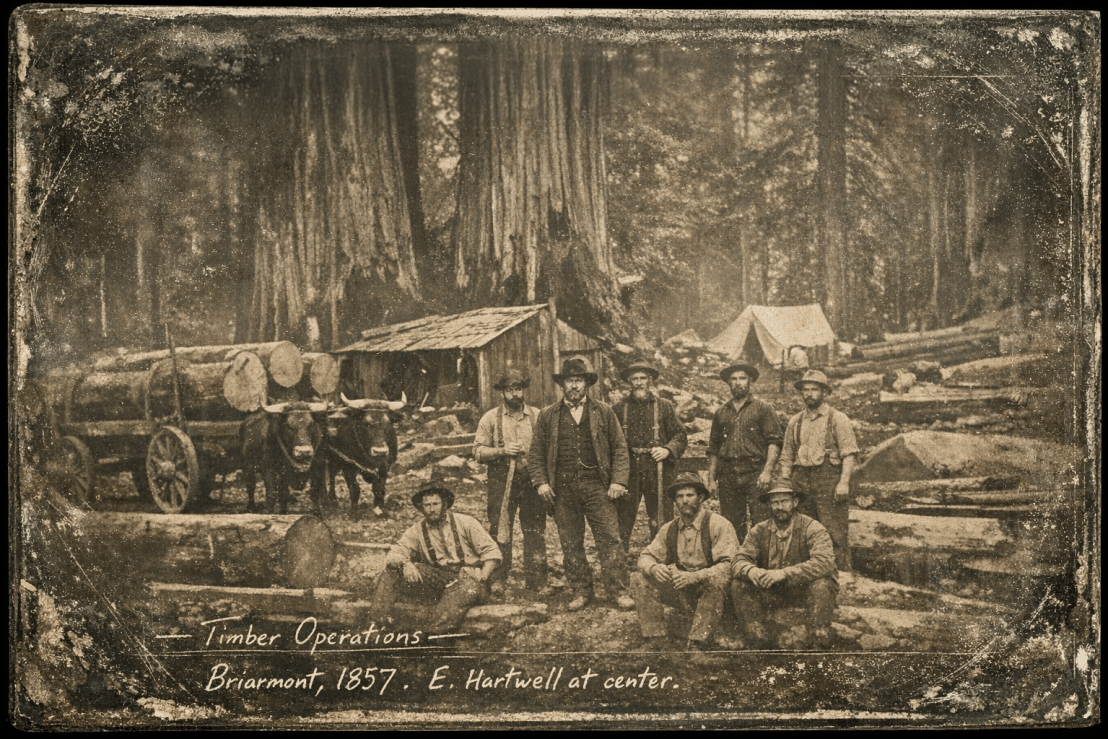
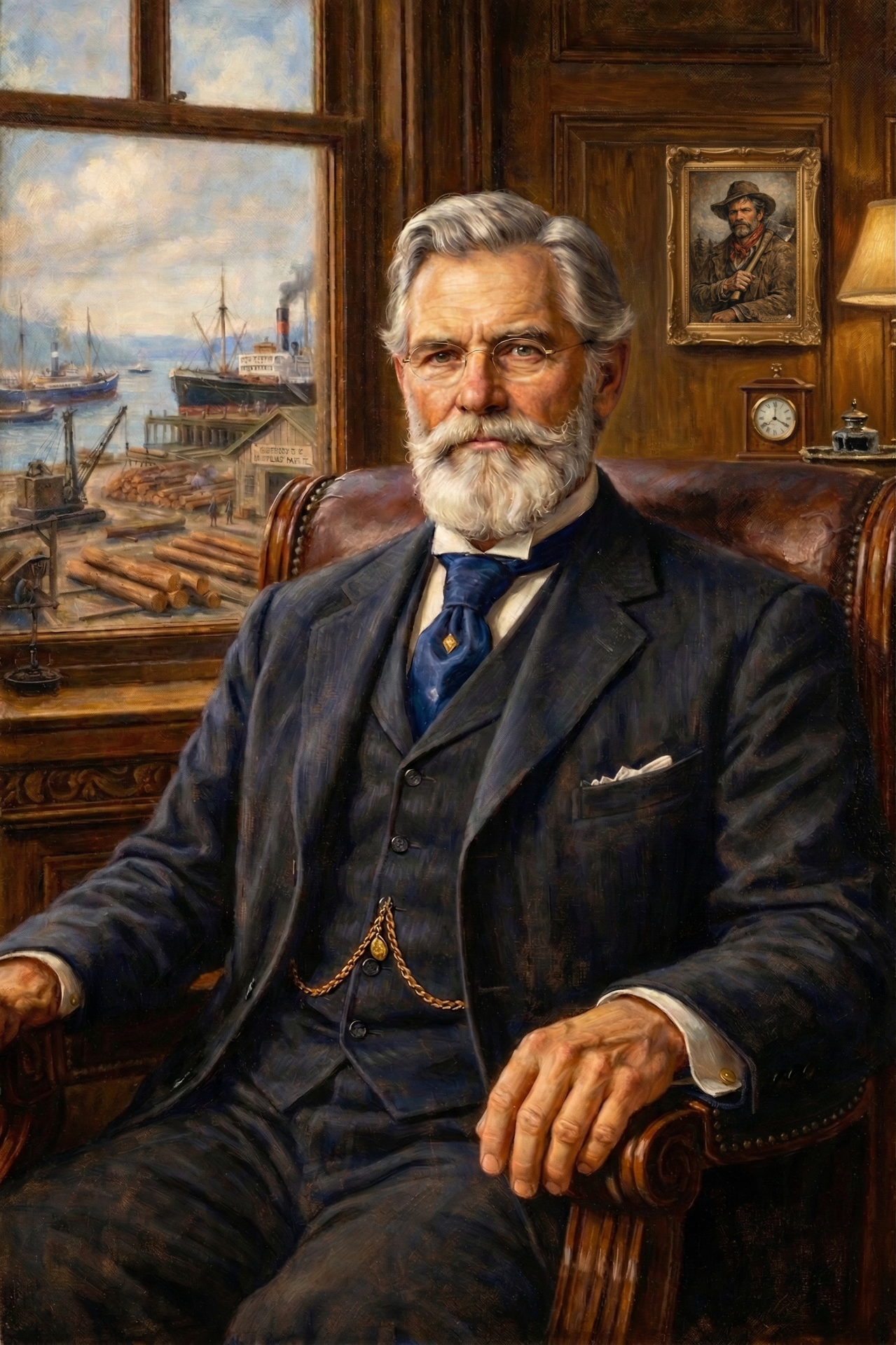
Elias Hartwell was one of Briarmont’s earliest and most consequential figures: a timber baron, industrial founder, and man of immense ambition whose will helped shape the town long before Oakridge ever stood upon his estate. He arrived in Northern California from Maine in 1856, already familiar with sawmills and timber camps, and quickly recognized what others had not yet fully grasped: that the redwood forests of the coast represented not only raw material, but power on a scale large enough to build a fortune.
He was not a romantic frontiersman, nor a visionary in any gentle sense. Hartwell belonged to a harder breed of builder. He was disciplined, exacting, and relentless, the sort of man who looked at wilderness and saw volume, transport, yield, and control. Under his leadership, Hartwell Timber Co. expanded aggressively through the surrounding lowland valleys, supplying lumber to a rapidly developing West and helping lay the material foundation for Briarmont itself.
That success came at a cost no one in Briarmont could ignore forever. The same operations that made Hartwell wealthy also stripped hillsides bare, destabilized the land, damaged watersheds, and contributed to the collapse of local salmon runs. Even in his own lifetime, Hartwell became a figure who inspired dependence, resentment, and unease in equal measure. He built Briarmont, but he also bound it to the appetite of an industry that could not last.
Early Life and Arrival in California
Hartwell was born in Maine and grew up around the sawmills and timber camps of New England, an upbringing that gave him both practical familiarity with the lumber trade and a sharper eye than most for the opportunities hidden inside expanding infrastructure. When he came west in 1856, he did so in the midst of the broader California rush, but unlike many others, he was not chasing gold. He was chasing permanence through industry. He understood that railroads, mines, ports, and settlements would all require lumber, and he intended to be the man who supplied it.
That instinct proved correct. By the early 1860s, he had established a milling operation along the coastal bluffs near what would become Briarmont, and from there began building one of the most productive lumber enterprises on the Northern California seaboard.
Temperament and Character
Elias Hartwell was not remembered as a warm man. He appears instead as a man of appetite, force, and command: highly intelligent, deeply self-assured, and possessed of the kind of ambition that treats hesitation as weakness. He understood systems, scale, and leverage. More importantly, he understood men. He knew how to organize labor, how to turn wilderness into a commodity, and how to make others depend on what he controlled. That kind of intelligence made him formidable. It did not make him kind. This harder reading of his character is supported by the private working summary, which casts him in 1911 as still greedy, stubborn, and convinced that money could solve the problems his own industry had created.
His refinement was real, but it was never innocent. Hartwell built a conspicuously refined estate on a rise overlooking the town he had effectively created: a stone-and-brick manor house with formal grounds, a private library, and multiple outbuildings, all set above land his own operations had stripped bare within living memory. The estate was not merely a residence. It was an expression of hierarchy. Hartwell did not live like the men who worked for him because he did not see himself as one of them.
Hartwell Timber Co. and the Making of Briarmont
Founded in 1857, Hartwell Timber Co. began as a modest eight-man operation and grew into a dominant regional enterprise overseeing extraction, milling, and transportation. At its height, the company controlled much of the local lumber trade, with redwood as one of its most valuable resources. Its timber fed the expansion of railroads, mines, and frontier settlements across the West.
The scale of that enterprise was instrumental in the founding of Briarmont Township. Lumber that could not be sold was often repurposed locally, while clay brick and regional stone were used alongside Hartwell timber to construct homes near Hartwell Manor and the company mill. A settlement formed first around labor and logistics, then around the merchants, tradesmen, and families whose livelihoods depended on the company’s continued success. For a time, Briarmont prospered under that arrangement.
But the prosperity Hartwell generated was inseparable from the damage he normalized. As his crews cut fast and moved on, erosion scarred the slopes, creeks silted over, and salmon runs deteriorated. What Hartwell built in economic terms, he undermined in ecological ones. That contradiction is central to his legacy.
Later Years
By the 1890s, even Hartwell could no longer entirely ignore the consequences of decades of unregulated harvesting. The hillsides above Briarmont were exposed and unstable, seasonal flooding had worsened, and the wider national conversation was beginning to shift toward conservation. Surviving old-growth stands in the upper mountain ridges gained new symbolic and scientific importance precisely because so much else had been lost.
Something in Hartwell appears to have shifted in those years, though not enough to absolve him. He slowed his operations and reportedly funded a small survey of the remaining old-growth stands above Briarmont, one of the earliest systematic efforts to document what had not yet been cut. In fragments of surviving correspondence, he is said to have spoken of the land “answering back” for what had been taken from it. Yet he undertook no large-scale restoration, and his wealth remained rooted in the same industry that had caused the damage in the first place. Whatever self-awareness came to him in old age, it did not transform him into a benevolent man. It merely sharpened the tragedy of what he had already set in motion.
Death and Aftermath
Elias Hartwell died in 1911 at the age of seventy-three. He had never married and had no children. His will directed that outstanding debts be settled through the sale of milling equipment, timber rights, and other movable assets. Because his business had already been strained by reduced output and long-term decline, there were many such debts. What remained, chiefly the estate itself and the land around it, was left in language vague enough to invite years of legal and civic uncertainty: “to the use and betterment of Briarmont and its people, in whatever manner may be deemed fitting by those who remain.”
That phrasing ensured Hartwell’s influence would outlast him. His milling infrastructure was sold or dismantled, and the company effectively came to an end, but the estate passed into civic limbo rather than disappearing into private inheritance. For several years, the property sat largely idle, overgrown and weathering, until the Briarmont trust established Oakridge Institute of Forestry and Land Sciences there in 1918. In one of Briarmont’s most pointed historical reversals, the land most closely associated with Hartwell’s extraction became the foundation for research, stewardship, and ecological study.
Legacy
Elias Hartwell’s legacy remains impossible to separate from contradiction. He was a builder, but also a destroyer. He created the conditions that allowed Briarmont to exist, while also inflicting the long-term damage that later generations would spend decades trying to understand and repair. His estate became Oakridge. His industrial shadow helped shape the institute’s mission. Even the Crenshaw Oak, planted in 1918 as a public symbol of restoration, only carried meaning because Hartwell’s damage had made such a gesture necessary in the first place.
He should not be remembered as a misunderstood benefactor, nor as a pantomime tyrant. He was something more dangerous than either: a man of intelligence, appetite, and will who built exactly the kind of world he believed he had the right to build, and who only in later years seemed to grasp that the land, unlike the men around him, would not remain obedient forever.