
 |
|
| Hartwell Timber Co. | |
| Type | Corporation, Mining/Resources |
|---|---|
| Founded | 1857 |
| Dissolved | 1911 |
| Founders | Elias Hartwell |
| Notable members | Amos Pike Bernard Kessler Clarence Ashton Edgar Briggs Gideon Rourke Levi Boone Nathaniel Vale |
| Other members | Holt Briggs Ward Ashton |
History
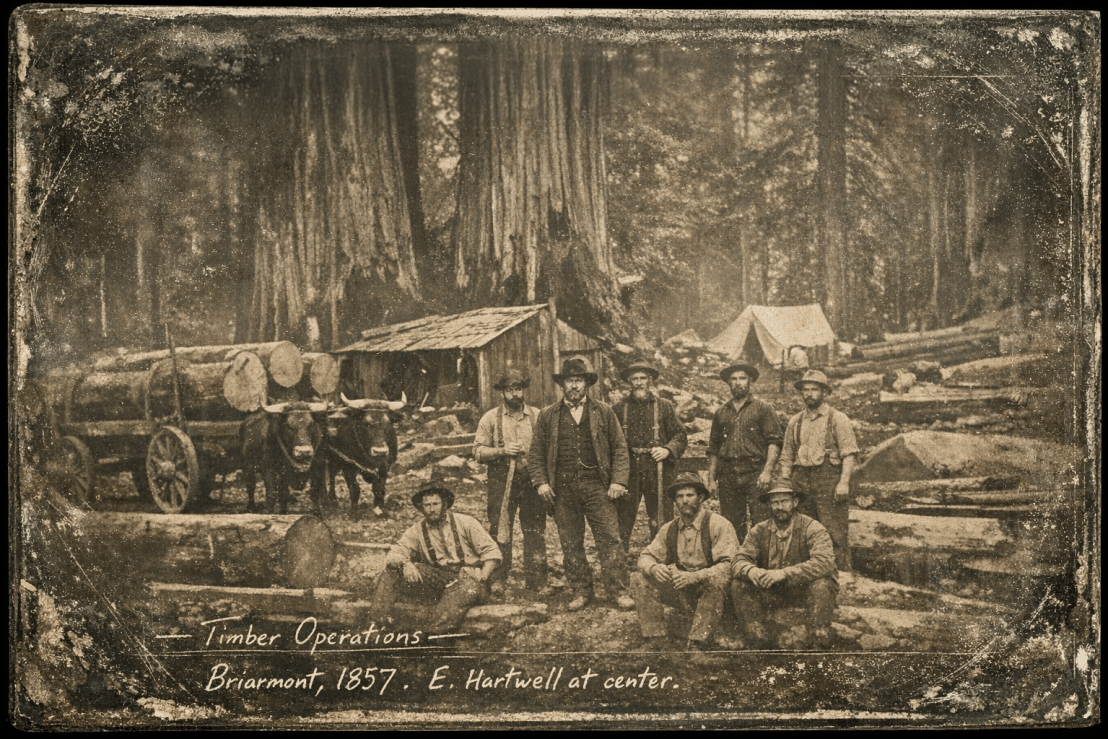
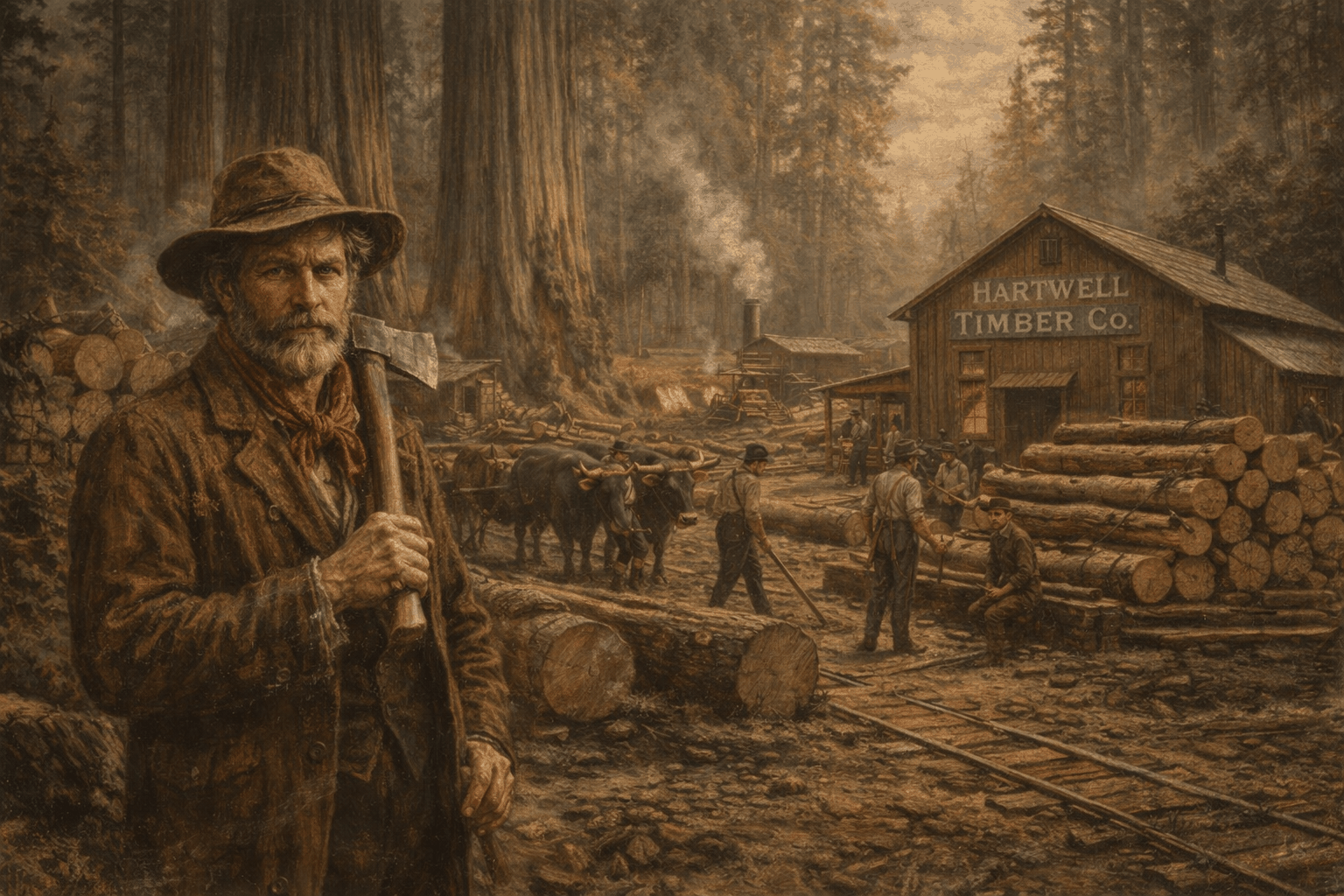
Founded in 1857 by Elias Hartwell, the Hartwell Timber Company began as a modest operation of eight men, including Hartwell, organized to supply lumber for the country’s rapid westward railroad expansion.
Hierachy
Elias Hartwell:
Founder and owner
Clarence Ashton:
Head of Operations
Levi Boone:
Camp carpenter and structural foreman
Gideon Rourke:
Hauling foreman and ox-team lead
Amos Pike:
Scout, surveyor, and route finder
Bernard Kessler:
Blacksmith and equipment mechanic
Nathaniel Vale:
Woods guide, hunter, and terrain specialist
Edgar Briggs:
Saw hand and camp medic
From those beginnings, Hartwell Timber Co. grew from a logging and transport concern into a dominant regional enterprise overseeing timber extraction, milling, and transportation. At its peak, the company dominated the local lumber trade, with redwood being one of its most valuable resources. Its timber was in high demand for railroad construction, mining operations, and the broader expansion of settlements along the western frontier.
The scale of Hartwell’s operations was instrumental in the founding of Briarmont Township. Lumber that could not be sold was often repurposed locally, while clay brick and regional stone were used alongside Hartwell timber to construct homes near Hartwell Manor and the company mill. Over time, a small settlement formed around the industry: first lumber workers and their families, then merchants, tradesmen, and other residents whose livelihoods depended on the company’s success.
For nearly thirty years, Briarmont prospered. The lumber trade drove the local economy, while salmon fishing and small game helped sustain the community. Imported goods, though costly, were brought in regularly enough to provide a standard of living that was unusually comfortable for a remote western settlement of the time.
That prosperity, however, came at a severe cost. As Hartwell Timber expanded, the surrounding landscape began to deteriorate. Creeks ran thick with silt. Salmon runs diminished. Hillsides once sheltered by dense forest were left exposed and unstable, and the wildlife that had once thrived in the region steadily disappeared alongside its habitat.
By the 1890s, the consequences of decades of unregulated harvesting had become difficult to ignore. Lumbering operations slowed significantly as accessible stands were depleted, and conservation sentiment began to grow at both the state and federal levels. Hartwell Timber Co. was forced to adapt, turning increasingly toward the planting and harvesting of other coniferous species such as pine, cypress, and Pacific yew.
Even so, the company never fully regained the momentum of its earlier years. As Hartwell Timber declined, Briarmont felt the effects almost immediately. The cost of imported goods, including dairy, meat, flour, and sugar, rose sharply, and the level of comfort the town had enjoyed during the company’s peak became increasingly difficult to maintain.
Disbandment
In his later years, Elias Hartwell reduced the pace of expansion, but the business had been built on constant output and could not easily adapt to contraction. Reduced production strained the company’s finances, and the industrial model that had once made Hartwell enormously successful became increasingly difficult to sustain.
When Hartwell died in 1911, the company was already under significant financial pressure. In accordance with his will, the company’s milling equipment, timber rights, and other movable assets were sold to settle outstanding debts. With its infrastructure dismantled and its holdings broken apart, the Hartwell Timber Company effectively came to an end.