
 | |
| The Crenshaw Oak | |
| Type | Tree |
|---|---|
| Planted | 1918 |
| Species | Coast Live Oak (Quercus agrifolia) |
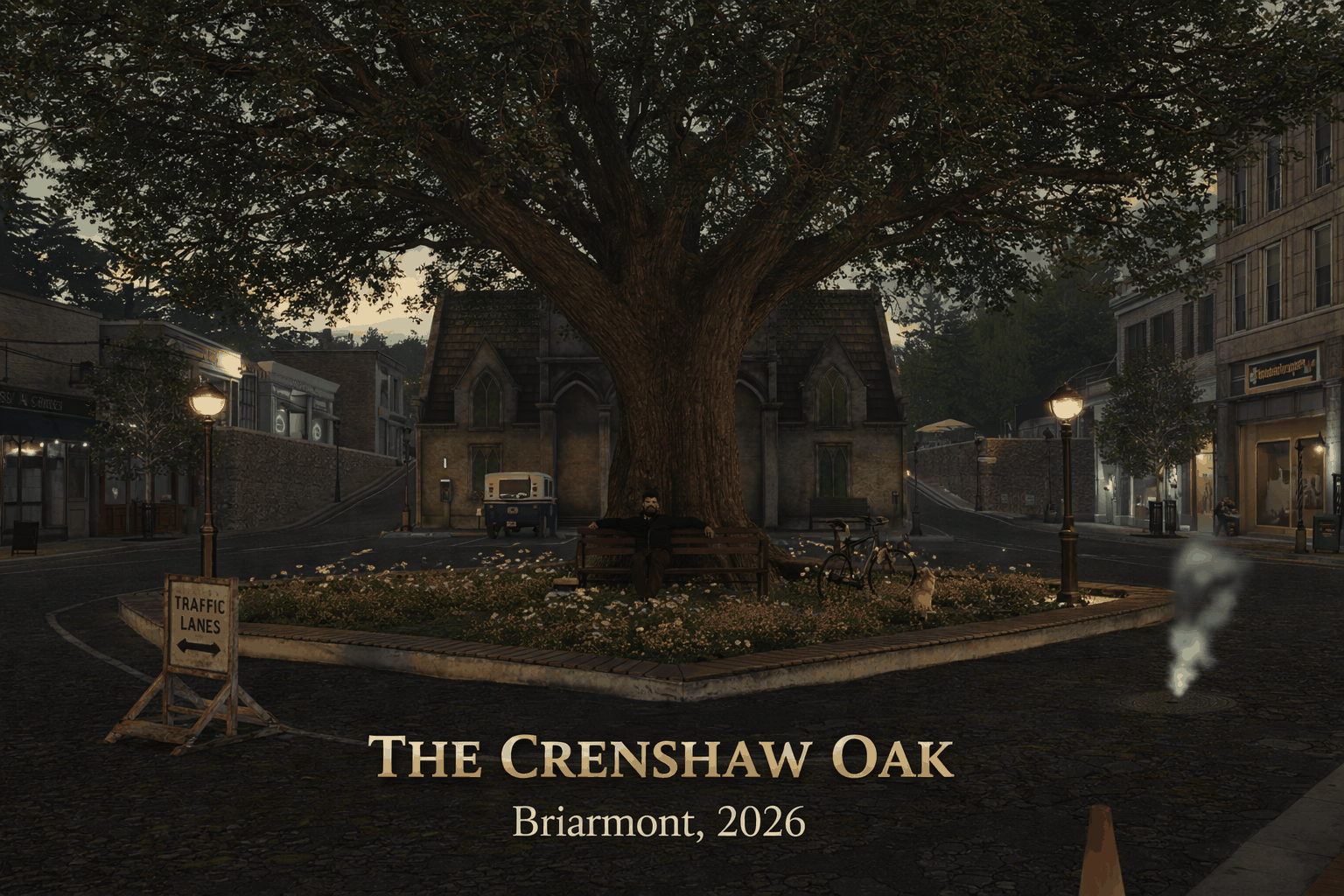
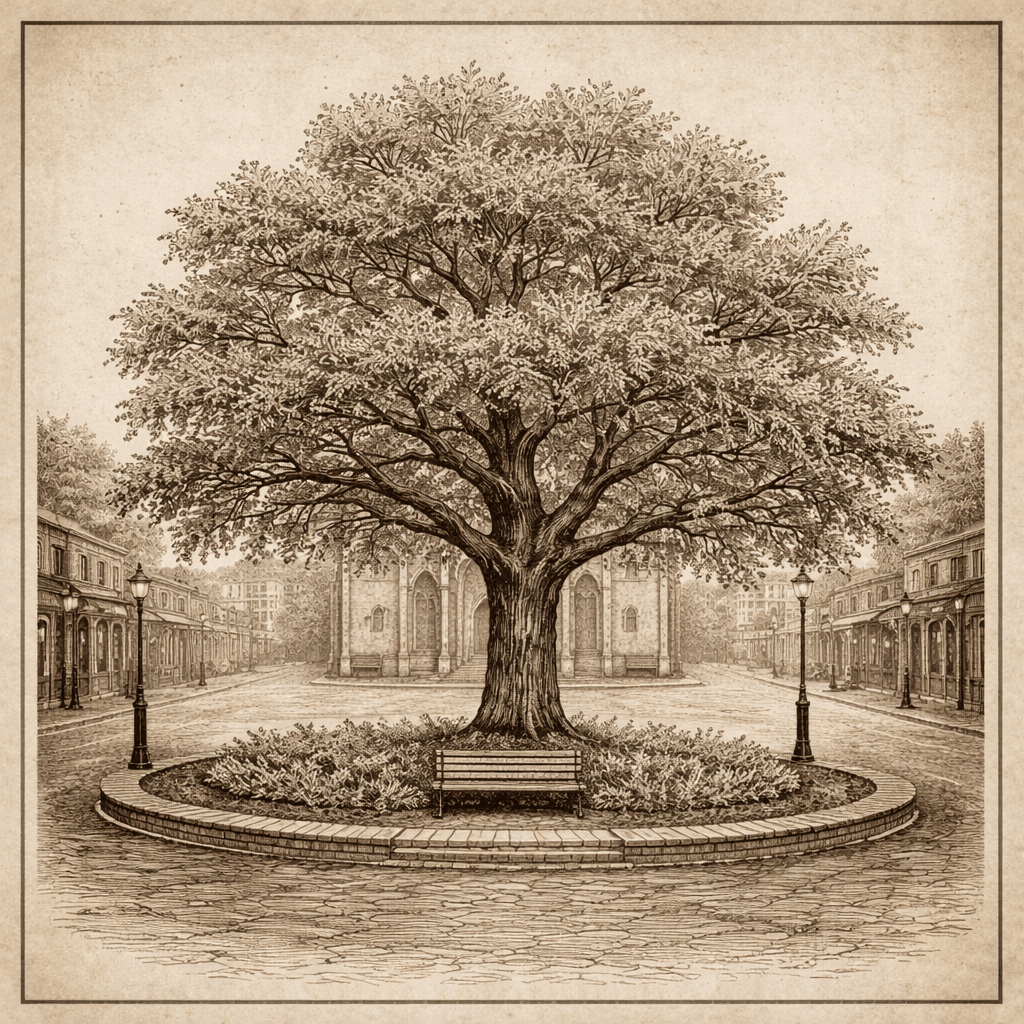
At the meeting of Crenshaw and Foundry Lane, near the beach and in the heart of Briarmont, stands the Crenshaw Oak: one of the town’s most familiar landmarks and one of its most quietly important. To visitors and many younger residents, it is simply a large, old tree in the center of the square. To those who know Briarmont’s history, it is a living symbol of the town’s long effort to repair what was damaged in the Hartwell years.
Location: Crenshaw Square
History
The oak was planted in 1918 by Theodore Crenshaw, the first head researcher appointed when the Oakridge Institute of Forestry and Land Sciences was established on the former Hartwell estate. Oakridge itself was founded that same year in direct response to the environmental ruin left behind by decades of industrial logging: eroded hillsides, damaged watersheds, and the long decline of the region’s salmon runs. From the beginning, the institute’s purpose was practical as much as academic. It existed to study sustainable forestry, ecological recovery, and the stewardship of the redwood landscape that had been so heavily scarred by Hartwell’s operations.
According to local tradition, Crenshaw planted the tree as a public act of commitment when he took up his post. Where Hartwell’s legacy had been extraction, the oak was meant to stand for restoration. It was not a grand solution to the scale of damage Briarmont had inherited, but it was visible, deliberate, and impossible to misunderstand. Crenshaw is said to have tended the tree personally for the rest of his life, watching over it as both a scientific interest and a moral promise.
After Theodore Crenshaw’s death, care of the tree passed formally into municipal hands. By then, the oak had already become closely associated with the town’s identity, and Briarmont moved to protect it. It was recognized as a historical landmark, with residents volunteering alongside the municipality to help maintain the square and safeguard the tree from neglect or damage. In that sense, the Crenshaw Oak ceased to belong to any one institution. Though planted under Oakridge’s early mission, it became part of Briarmont itself.
Its meaning shifted again as Oakridge evolved. What began in 1918 as the Oakridge Institute of Forestry and Land Sciences later grew into Oakridge College, expanding beyond its original environmental and land-science mission while still preserving that founding history. Over the decades, this brought generations of students into Briarmont, many of whom passed the square without any understanding of what the tree represented. To some, it was only a tree. To others, especially longtime residents, that indifference became part of the story too: a reminder of how easily history can survive in plain sight and still go unread.
Sometime in the 1980s, the square was further formalized with the addition of a bench and commemorative plaque. The dedication honored Theodore Crenshaw’s role in the town’s recovery and explicitly tied the oak to his lifelong commitment to restoring what Hartwell and the timber industry had destroyed. Since then, the bench and flower bed have become as much a part of the landmark as the tree itself, transforming the center of the square into both a memorial and a vibrant part of everyday town life.
Today, the Crenshaw Oak stands as both a landmark and a warning. It is a beautiful thing, but not merely decorative. It marks the point where Briarmont chose, however imperfectly, to turn from exploitation toward care. The tree does not erase Hartwell’s damage, nor the long history of extraction that made Briarmont possible in the first place. Instead, it endures as proof that the town chose to openly acknowledge the damage and place that memory at its center, rather than hide it.